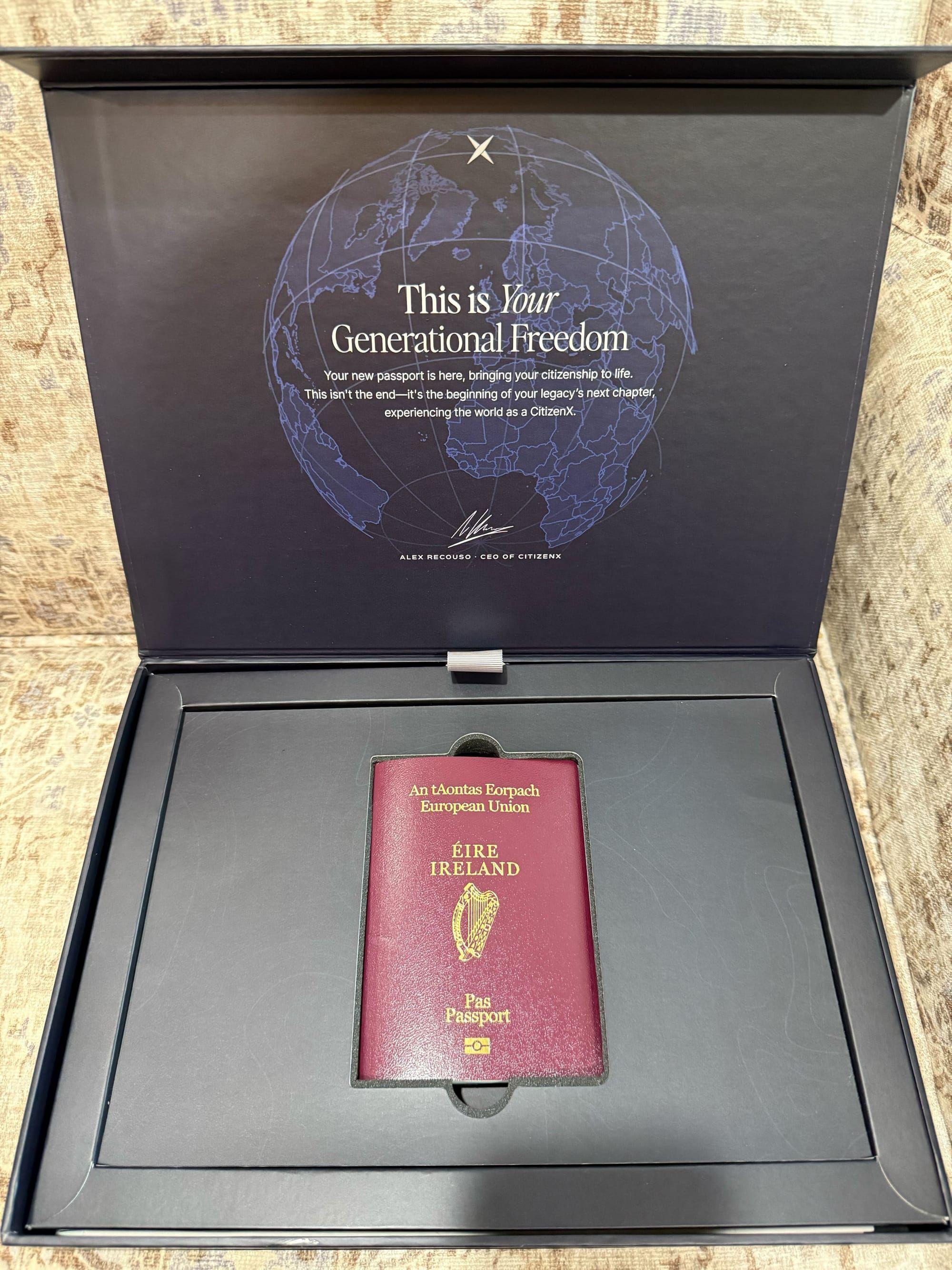
The journey to Irish citizenship through ancestry has become increasingly appealing in our globalized world. An Irish passport opens doors not just to Ireland but to the entire European Union, offering mobility, work rights, and a connection to ancestral roots.
For many with Irish heritage, particularly in the United States, Canada, Australia, and other countries with significant Irish diaspora populations, exploring this connection has practical and emotional value. The allure of reclaiming citizenship from the land of your ancestors resonates deeply with many.
But what about those whose closest Irish-born relative is a great-grandparent? This is where the path becomes more nuanced. While Ireland has generous ancestry-based citizenship provisions, there are specific rules about who qualifies and how the lineage must be maintained.
Irish passport
In this comprehensive guide, we'll explore exactly what the Irish law says about citizenship through a great-grandparent, what pathways might be available, and what steps you need to take if you're eligible. We'll delve into the legal framework, application process, financial implications, and practical considerations to give you a complete picture of what's possible and what isn't.
Whether you're just beginning to explore your Irish roots or you're already gathering documents for an application, this guide will help you navigate the complexities of Irish citizenship by descent when your connection is through a great-grandparent.
1. Legal Eligibility Criteria: Can You Claim Irish Citizenship Through a Great-Grandparent?
The short answer might surprise you: having an Irish great-grandparent alone typically does not qualify you for Irish citizenship by descent. Ireland's citizenship laws extend generosity to those with Irish heritage, but there are clear generational limits.
Irish nationality law allows citizenship by descent under specific conditions outlined in the Irish Nationality and Citizenship Act 1956 (as amended). You're eligible to become an Irish citizen by descent if either:
One of your parents was an Irish citizen at the time of your birth (even if that parent was not born in Ireland), or
One of your grandparents was born in Ireland
This second provision is where many people find their pathway to Irish citizenship - through an Irish-born grandparent. If your grandparent was born on the island of Ireland, you have a clear right to claim Irish citizenship by registering on the Foreign Births Register (FBR).
But what about great-grandparents? This is where things get tricky. Ireland does not allow you to "skip" generations when claiming citizenship by descent. The lineage must be maintained through each generation.
For someone with an Irish great-grandparent to be eligible, the chain of citizenship must have been preserved through the intermediate generations. Here's how it would need to work:
Your great-grandparent (Generation A) was born in Ireland.
Your grandparent (Generation B) would have been entitled to Irish citizenship as a child of an Irish-born parent. But if born abroad, they would need to claim it through registration on the FBR.
Your parent (Generation C) would only be an Irish citizen if Generation B had already claimed Irish citizenship before Generation C was born.
Finally, you (Generation D) would only be entitled to claim Irish citizenship if your parent was already an Irish citizen at the time of your birth.
In other words, the citizenship must flow continuously from generation to generation, with each generation claiming their citizenship before the next generation is born. You cannot claim directly through a great-grandparent if the intermediate generations didn't maintain their citizenship.
The Irish Department of Foreign Affairs confirms that Foreign Birth Registration is available only to people with "a grandparent born in Ireland or a parent who has obtained Irish citizenship through the FBR or naturalisation."
This creates a significant limitation for many with Irish great-grandparents. Unless your parent or grandparent already established their Irish citizenship, you likely cannot claim through descent alone.
2. Understanding the Foreign Births Register vs. Alternative Pathways
Since most people with only a great-grandparent connection cannot claim citizenship directly through descent, it's important to understand both the standard path (Foreign Births Register) and alternative options that might be available.
The Foreign Births Register (FBR)
The FBR is the official register for recording births abroad to Irish citizens. Entry in this register is how citizenship by descent is officially granted. For those who qualify through a parent or grandparent, this is the pathway to Irish citizenship.
The process involves submitting an online application, gathering extensive documentation to prove your lineage, paying a fee (currently €278 for adults, €153 for children), having your application witnessed by an appropriate professional, and then submitting everything by mail.
Once approved and entered in the FBR, you receive a certificate confirming your Irish citizenship. The date of your citizenship is the date of registration, not your birthdate.
As we've established, this pathway is generally not available if your closest Irish-born relative is a great-grandparent, unless the intermediate generations (your parent or grandparent) had already claimed their Irish citizenship in the proper sequence.
Citizenship by Irish Association
For those with an Irish great-grandparent but no closer Irish citizen relatives, there is an alternative pathway known as citizenship by "Irish associations." This is outlined in Section 16 of the Irish Nationality and Citizenship Act 1956.
This provision gives the Minister for Justice discretion to waive normal naturalization requirements for an applicant of Irish descent or with Irish associations. Being of "Irish associations" explicitly includes having an Irish citizen ancestor.
However, this pathway comes with significant conditions:
You must establish a substantial connection to Ireland, usually by residing in Ireland for a considerable period. Policy guidance indicates a minimum of 3 years of legal residence in Ireland is expected.
The decision is entirely at the discretion of the Minister. Even with the required residence, there's no guarantee of approval.
You must meet other basic naturalization requirements (good character, intention to continue residing in Ireland, etc.).
This path requires a commitment to living in Ireland first before applying for citizenship. It's not a direct claim based on ancestry but rather a special consideration for naturalization based on your Irish heritage.
Applications based on descent more remote than a great-grandparent (e.g., great-great-grandparent) are generally refused. Even with a great-grandparent connection, approval is not routine or guaranteed.
In summary, for most people whose closest Irish-born relative is a great-grandparent, the citizenship by Irish association route requires actually moving to Ireland for a substantial period before applying. This is significantly different from the FBR process, which allows you to claim citizenship while living abroad.
3. Documentation Requirements: Proving Your Irish Lineage
Whether you're pursuing the FBR route (if eligible) or considering the Irish association pathway after moving to Ireland, proving your lineage with proper documentation is crucial. The paperwork requirements are substantial and often span multiple generations and countries.
Documents Required for Foreign Births Register Applications
If you are among the minority of people with a great-grandparent connection who can apply through the FBR (because your parent or grandparent already registered), you'll need a complete paper trail from yourself back to the Irish-born ancestor.
These typically include:
Your Own Documents:
Original long-form birth certificate (showing your parents' details)
Valid government-issued photo ID (passport or driver's license, certified copy)
Proof of current address (utility bill, bank statement, etc.)
Marriage certificate or change-of-name document (if applicable)
Four passport-sized photographs (two signed by you and certified by a witness)
Ancestor Documents:
Birth certificate of your Irish-born ancestor (e.g., great-grandparent)
Birth certificates for each generation between (your grandparent, your parent)
Marriage certificates (to establish name changes through marriage)
Death certificates if relatives are deceased
Proof that the intermediate generations registered their Irish citizenship (critical for great-grandparent claims)
Every document must be an official civil document - church baptismal records or photocopies are not sufficient. The documents must also clearly establish the chain of descent from generation to generation.
For great-grandparent claims specifically, you'll need proof that your grandparent registered on the FBR before your parent was born, or that your parent registered before you were born. This is typically in the form of their FBR certificates.
Documents for Irish Association Applications
If pursuing citizenship after residing in Ireland based on your Irish great-grandparent connection, you'll need similar documentation proving your Irish heritage, plus:
Proof of your residence in Ireland (typically for at least 3 years)
Evidence of your integration into Irish society
Character references
Financial stability documentation
Standard naturalization application forms and requirements
The documentation requirements for both pathways are extensive and often the most challenging part of the process. Many records may be decades old or from multiple countries, requiring time and persistence to obtain.
Practical Tips for Document Collection
Gathering these documents requires planning and patience. Here are some practical tips:
Start with what you have - birth certificates, family records, etc.
Work backward systematically, one generation at a time.
If you're missing records, check with national archives, vital records offices, or county offices in the relevant countries.
For Irish birth certificates from before 1864, church records may be the only option. The National Library of Ireland has digitized many parish registers.
For more recent Irish certificates, contact the General Register Office of Ireland.
Allow plenty of time - obtaining some documents can take months, especially if they need to be ordered from multiple countries.
Get multiple certified copies of important documents, as you may need them for other purposes.
If documents are not in English or Irish, obtain official translations.
Remember that the burden of proof is on you as the applicant. The clearer and more complete your documentation, the smoother the process will be.
4. The Application Process: Step-by-Step Guide
If you've confirmed your eligibility (either through the FBR because your parent/grandparent already registered, or by planning to move to Ireland for the Irish association route), here's what the application process looks like:
Foreign Births Register Application Process
Confirm Eligibility: Use the online tool provided by the Immigration Service to check if you qualify for Irish citizenship by birth or descent.
Gather Required Documents: Collect all necessary documentation as outlined in the previous section. This is often the most time-consuming step.
Complete the Online Application: Visit the Department of Foreign Affairs Foreign Births Register online application system. Create an account, fill out the form with your personal details and information about your Irish ancestor. Submit the form electronically and print out a copy.
Pay the Fee: The current fee is €278 for adults and €153 for children. Payment is made online at the time of application submission.
Get the Application Form Witnessed: The printed application must be signed in the presence of an approved witness (doctor, lawyer, notary, police officer, etc.). The witness will certify your identity, verify your photographs by signing two of them, and certify copies of your identification.
Mail the Application Package: Send the signed and witnessed form, along with all required original documents, to the Department of Foreign Affairs FBR unit in Ireland. Use a secure courier or registered mail service.
Wait for Processing: Current processing times are around 9 months. During this time, you may be contacted if there are any issues with your application.
Certificate Issuance: Once approved, you'll receive an official certificate of entry in the Foreign Births Register, stating that you are an Irish citizen from the date of registration.
Apply for an Irish Passport: With your FBR certificate, you can apply for an Irish passport through the Passport Office. This is a separate process with its own requirements and fees.
Irish Association Application Process (After Residing in Ireland)
If you're pursuing the Irish association route due to having a great-grandparent connection:
Move to Ireland: Establish legal residence in Ireland through appropriate visas or permits.
Live in Ireland for at Least 3 Years: During this time, integrate into society, maintain good standing, and keep records of your residence.
Apply for Citizenship by Naturalization: Submit Form 8 (Application by a Person of Irish Descent or Irish Associations for a Certificate of Naturalization) to the Immigration Service Delivery.
Include Supporting Documentation: Provide evidence of your Irish ancestry, residence in Ireland, good character, and intention to continue residing in Ireland.
Pay the Application Fee: The standard naturalization fee applies (currently €175 for the application, plus €950 if approved).
Attend an Interview: You may be called for an interview as part of the process.
Wait for Decision: Processing times vary, but citizenship applications can take 12-24 months.
Attend Citizenship Ceremony: If approved, you'll be invited to a citizenship ceremony where you'll take an oath of fidelity and receive your certificate of naturalization.
For both pathways, patience is essential. These are not rapid processes, and careful attention to detail is crucial for success.
5. Financial Analysis: Tax Implications and Economic Considerations
Becoming a dual Irish citizen has various financial implications that are worth understanding before you proceed. It's important to distinguish between obligations (such as potential taxes) and benefits (such as property rights or social advantages).
Tax Obligations for Irish Dual Citizens
Good news: Ireland's tax system is based on residency and domicile, not on citizenship. Unlike countries like the United States that tax their citizens' worldwide income regardless of where they live, Ireland does not impose tax on citizens who live abroad.
An Irish citizen who is non-resident in Ireland is generally liable to Irish income tax only on Irish-source income (if any). In other words, if you live outside Ireland and earn no income from Irish sources, you typically have no Irish tax liability simply from holding Irish citizenship.
You would become an Irish tax resident if you spend 183 days or more in Ireland in a calendar year, or 280 days over two consecutive years (with at least 30 days in each year). Only then would broader tax obligations arise.
For those who do become tax residents in Ireland, the rules are the same for citizens and non-citizens alike. If you are resident and domiciled in Ireland, you would pay Irish tax on your worldwide income. If resident but not domiciled (for example, an American who settles in Ireland but intends to return to the U.S.), you are taxed on Irish-source income and only on foreign income that you remit into Ireland.
Ireland has an extensive network of tax treaties to prevent double taxation of the same income. This means if you owe tax to both Ireland and another country on the same income, treaties usually provide credits or exemptions to avoid paying twice.
For those with significant wealth, Ireland has a domicile levy of €200,000 that applies in rare cases to wealthy Irish-domiciled individuals who are tax resident abroad, have worldwide income exceeding €1 million, own Irish property worth over €5 million, and pay less than €200,000 in Irish income tax annually. However, this affects only a tiny fraction of dual citizens.
In practical terms, for most dual Irish citizens living outside Ireland, there are no ongoing tax obligations to Ireland unless you have Irish-source income or spend significant time there.
Property Ownership Rights and Financial Advantages
Ireland places no restrictions on foreign nationals owning property, so gaining Irish citizenship doesn't provide a special advantage in property ownership rights. Non-citizens can already buy Irish property freely.
However, there are some practical benefits to property ownership as a citizen:
As an Irish citizen, you have the automatic right to live and work in Ireland. This can make financing easier when purchasing property, as banks may view you as a lower risk.
If you decide to make Ireland your primary residence, you can designate a property as your principal private residence, making any future capital gain on its sale exempt from capital gains tax.
Irish/EU citizenship gives you the right to live, work, and own property anywhere in the EU, expanding your options beyond just Ireland.
There are no property taxes specific to citizens versus non-citizens. Stamp duty on purchase and Local Property Tax on ownership apply equally to everyone.
Social Benefits and State Contributions
Irish citizenship grants you the right to access public services and social welfare on the same basis as other citizens, but most benefits require actual residence in Ireland and/or paying into the system.
Many social welfare benefits require meeting the "Habitual Residence Condition" (HRC). Even Irish citizens returning from abroad must satisfy this by resettling in Ireland for a period before claiming certain welfare payments.
If you live and work in Ireland, you'll pay PRSI (Pay Related Social Insurance) contributions from your salary, which funds social insurance benefits like pensions and unemployment benefits. Over time, these contributions earn you the right to the State Pension (Contributory) and other benefits.
One significant advantage of EU citizenship is that under EU regulations, pension contributions in different EU countries are aggregated toward your pension eligibility. If you work in multiple EU countries during your career, each country will pay you a pro-rated pension based on your contributions there.
In educational terms, Irish citizens can attend universities in Ireland and other EU countries at much lower tuition rates than those charged to non-EU international students. This can represent substantial savings for those pursuing higher education.
Overall, dual citizenship with Ireland does not impose financial burdens on those living outside Ireland. There are no annual fees, required donations, or citizen-based taxes. Obligations only arise if you actually live or earn in Ireland, just as they would for any resident.
6. Citizenship Implications for Different Age Groups
The path to Irish citizenship through ancestry affects different age groups in unique ways, with varying considerations and benefits depending on your stage of life.
For Young Adults (18-35)
For younger individuals, Irish citizenship offers particularly valuable mobility and opportunity benefits:
EU-Wide Work Rights: The ability to live and work anywhere in the EU without visas or work permits is especially valuable early in your career. This opens up internships, job opportunities, and the chance to gain international experience.
Educational Opportunities: Access to EU universities at local tuition rates rather than international fees can represent savings of tens of thousands of euros. This makes studying abroad much more accessible.
Working Holiday Options: Irish passport holders have access to more working holiday visa schemes worldwide than many other nationalities.
Building a Global Career: The flexibility to move between countries and gain experience in different markets can be career-enhancing.
Long-Term Planning: Establishing Irish citizenship early means you can potentially pass it to future children.
Young adults are also typically better positioned to consider the Irish association route if direct descent isn't an option, as relocating to Ireland for three years might align with career opportunities or educational pursuits.
For Mid-Career Professionals (36-55)
Mid-career individuals may find different aspects of Irish citizenship valuable:
Career Mobility: The ability to accept positions throughout the EU without work permit concerns.
International Business Opportunities: Easier travel and the right to establish businesses across the EU.
Educational Opportunities for Children: EU citizenship benefits extend to dependent children under 18.
Property Investment: While anyone can purchase property in Ireland, as a citizen you have the right to live there indefinitely, making investment potentially more practical.
Retirement Planning: Begin considering options for eventual retirement in Ireland or elsewhere in the EU.
For those in this age group whose parents are still alive, there might be strategic value in having your parent claim Irish citizenship first (if they qualify through an Irish-born parent), potentially opening a path for you.
For Retirees and Seniors (56+)
For older individuals, Irish citizenship can offer different kinds of security and options:
Retirement Destination Options: The freedom to retire anywhere in the EU without visa constraints.
Healthcare Access: As an Irish/EU citizen resident in Europe, you gain access to national healthcare systems.
Pension Integration: If you've worked in multiple countries, EU rules help coordinate pension benefits.
Estate Planning Benefits: While inheritance tax applies based on the location of assets rather than citizenship, having options for where to establish residency can affect overall estate planning.
Family Legacy: For many older people, establishing Irish citizenship is about reconnecting with heritage and creating a legacy for future generations, even if they personally may not use all the benefits.
Seniors may find the residency requirement for the Irish association pathway more challenging, but some still pursue it as part of retirement plans or to spend extended time connecting with their ancestral homeland.
For all age groups, the emotional value of reconnecting with ancestral roots can be significant, regardless of the practical benefits. Many report a profound sense of completion in reclaiming the citizenship their ancestors held before emigrating.
7. Challenges and Limitations of the Great-Grandparent Route
Pursuing Irish citizenship through a great-grandparent connection comes with distinct challenges and limitations that should be clearly understood before investing significant time and resources.
The Generation Chain Requirement
The most fundamental limitation is that Irish citizenship generally cannot skip generations. Each generation must claim their citizenship before the next is born for the chain to continue. This means:
If your great-grandparent was Irish-born but your grandparent never registered for citizenship before your parent was born, the chain is broken.
If your grandparent did register but your parent never claimed Irish citizenship before you were born, the chain is likewise broken.
This requirement often eliminates the possibility of direct citizenship by descent for those whose only Irish connection is through a great-grandparent, as many families did not maintain formal citizenship registration across generations.
Documentation Challenges
Even if you believe the generational chain may have been maintained, proving it presents significant documentation challenges:
Records from three or four generations back can be difficult to locate, especially if they're from multiple countries.
Some necessary documents may have been lost, destroyed, or never created in the first place.
Name changes, particularly for women through marriage, can complicate establishing the connection.
Inconsistencies in how names were recorded across different documents can create problems with applications.
Translation requirements for non-English documents add another layer of complexity.
Time and Financial Investment
The pursuit of Irish citizenship through a great-grandparent involves considerable investment:
The process can take years from start to finish, especially when accounting for document collection and application processing times.
Application fees, document retrieval costs, translation services, postal fees, and potentially legal consultation can add up to a significant amount.
If pursuing the Irish association route through residency, the costs of relocating to and living in Ireland for at least three years represent a major financial commitment.
The Discretionary Nature of Irish Association Applications
For those considering the residency pathway due to having only a great-grandparent connection, it's important to understand the discretionary nature of these applications:
There is no guarantee of approval even after meeting the residency requirement.
The Minister for Justice has complete discretion in these cases.
Each application is judged individually on its merits, including the applicant's character, demonstrated links to Ireland, and other factors.
This pathway requires a significant commitment (moving to Ireland) with an uncertain outcome.
Maintaining Citizenship Going Forward
Once citizenship is obtained, there are considerations for maintaining it and potentially passing it to future generations:
Irish citizenship does not automatically transfer to existing children born before you became a citizen.
For future children, you would need to register their birth in the Foreign Births Register to maintain their citizenship rights.
Some countries do not permit dual citizenship, which could create complications depending on your current nationality.
Despite these challenges, many people with Irish great-grandparents do successfully pursue citizenship, either because they discover that the chain of citizenship was maintained, or because they commit to the residency pathway. The key is approaching the process with realistic expectations, patience, and thorough preparation.
8. Alternative Routes to Irish Connections
If obtaining citizenship through a great-grandparent proves difficult or impossible, there are other ways to establish meaningful connections with Ireland and gain some of the benefits of Irish heritage.
Irish Heritage Cards and Certificates
While not conferring legal rights, Ireland offers symbolic recognition of diaspora connections:
The Certificate of Irish Heritage was a government initiative (now discontinued officially but available through private providers) that recognized foreign-born individuals of Irish descent.
Various heritage organizations offer membership and recognition programs that connect you with your Irish roots.
These options provide symbolic acknowledgment of your Irish ancestry and can help you connect with the broader Irish diaspora community.
Residency Options Without Ancestry Claims
If citizenship through descent isn't viable but you're still interested in living in Ireland, several residency pathways exist:
Work Permits: Skilled professionals can obtain work permits for employment with Irish companies.
Investor and Entrepreneur Programs: Ireland offers residence permissions for those making significant investments in Irish businesses or starting their own enterprises.
Study Visas: Pursuing education in Ireland can provide a foothold that may lead to work opportunities and eventually permanent residency.
Retirement Visas: Ireland has provisions for financially self-sufficient retirees to establish residency.
These pathways don't rely on ancestry but can still lead to permanent residency and eventually citizenship through standard naturalization (typically after 5 years of residence).
Cultural and Community Engagement
Many find meaningful connections to their Irish heritage through non-legal channels:
Irish Cultural Organizations: Groups dedicated to Irish language, music, dance, and cultural preservation exist worldwide.
Heritage Tourism: Visiting ancestral hometowns and researching family history can create profound connections.
Irish Studies: Academic programs focusing on Irish history, literature, and culture offer in-depth engagement with heritage.
Community Service: Volunteering with Irish-focused charities or community groups can provide meaningful connection to Irish values and communities.
The Ireland-UK Common Travel Area
For those with UK citizenship or residency, the Common Travel Area (CTA) provides many benefits similar to Irish citizenship:
The CTA allows British and Irish citizens to move freely and reside in either country.
It includes rights to work, study, vote in certain elections, and access social welfare benefits and health services.
This arrangement exists independently of EU membership and was not affected by Brexit.
If you have easier access to UK citizenship through other ancestry paths, this could indirectly provide many of the benefits of Irish connection.
Future Possibilities
Ireland's citizenship laws have evolved over time and could potentially change again:
Advocacy groups occasionally campaign for extending citizenship rights to additional generations.
As awareness of diaspora connections grows, there may be new programs or pathways created.
Keeping informed about changes to Irish immigration and citizenship law is worthwhile if you have Irish heritage.
While these alternatives may not provide the full legal status of citizenship, they offer ways to honor your Irish heritage, establish meaningful connections with Ireland, and in some cases, create pathways to eventual residency or citizenship through other means.
9. The Practical Benefits of Irish (EU) Citizenship
Despite the challenges of qualifying through a great-grandparent, the benefits of Irish citizenship make it worth pursuing for those who are eligible. Here's what an Irish passport can offer:
European Union Rights and Freedoms
As an Irish citizen, you automatically become a citizen of the European Union, which grants you:
Freedom of Movement: The right to live, work, and study in any of the 27 EU member states without requiring visas or work permits.
Equal Treatment: Protection against discrimination based on nationality when it comes to employment, working conditions, and social security.
Political Participation: The right to vote and stand as a candidate in European and municipal elections in any EU country where you reside.
Consular Protection: The right to seek help from the embassy or consulate of any EU country if you're in a non-EU country where your own country isn't represented.
These EU rights significantly expand your personal and professional options beyond just Ireland itself.
Global Travel Benefits
An Irish passport provides excellent global mobility:
Visa-Free Travel: Irish passport holders can visit approximately 188 countries without a visa or with visa-on-arrival, making it one of the most powerful passports in the world.
Reduced Border Scrutiny: In many regions, EU passports generally receive less intensive scrutiny at border crossings.
Consular Assistance: Access to Ireland's network of embassies and consulates worldwide, plus the ability to seek help from any EU country's diplomatic missions if Ireland doesn't have representation.
These travel benefits make international exploration and business significantly easier.
Interested in another EU option? Consider Malta
Go premium with Malta, EU residency first, a vetted path to citizenship next, and seamless Schengen mobility for you and your family.
Irish citizenship opens doors to educational advantages:
EU Tuition Rates: Access to universities across the EU at local student rates rather than the much higher international fees.
Erasmus+ Program: Eligibility for EU exchange programs and educational grants.
Research Opportunities: Access to EU-funded research positions and grants.
Recognition of Qualifications: Easier recognition of qualifications across EU member states.
These educational benefits can represent savings of tens of thousands of euros and access to some of the world's top universities.
Healthcare Access
Irish citizenship provides healthcare advantages:
European Health Insurance Card (EHIC): Coverage for temporary stays in other EU countries.
Healthcare Rights: The right to access public healthcare systems in EU countries where you establish residency.
Coordination of Social Security: Protection of healthcare rights when moving between different EU countries.
For those who travel frequently or plan to retire in Europe, these healthcare benefits can provide significant peace of mind and financial protection.
Professional and Business Advantages
For professionals and entrepreneurs, Irish citizenship offers:
Unrestricted Work Rights: No need for work permits or visa sponsorship anywhere in the EU.
Business Establishment: The right to establish and run a business in any EU country.
Professional License Recognition: Simplified processes for recognizing professional qualifications across the EU.
Equal Treatment: Protection against nationality-based discrimination in employment and business.
These advantages can significantly enhance career opportunities and business potential.
Identity and Heritage Connection
Beyond the practical benefits, Irish citizenship offers meaningful personal value:
Reconnection with Heritage: A formal acknowledgment of your Irish ancestry and family history.
Participation in Irish Society: The ability to fully participate in Irish civic life if you choose to spend time there.
Legacy for Future Generations: The ability to pass Irish citizenship to your children, preserving the connection for future generations.
For many in the Irish diaspora, this sense of reconnection with ancestral roots holds profound emotional significance.
10. Conclusion: Is Pursuing Irish Citizenship Through a Great-Grandparent Worth It?
The path to Irish citizenship through a great-grandparent is challenging and not available to everyone. However, for those who qualify or are willing to pursue alternative routes, the benefits can be substantial.
Key Takeaways
Standard Eligibility Limitations: Having an Irish great-grandparent alone typically doesn't qualify you for citizenship by descent. The generational chain must have been maintained, with each generation registering before the birth of the next.
Alternative Pathway: If direct descent isn't an option, the citizenship by Irish association route requires residing in Ireland for at least three years before applying, with approval at the Minister's discretion.
Significant Benefits: Irish citizenship offers powerful advantages, including EU freedom of movement, global travel privileges, educational opportunities, healthcare access, and professional benefits.
Documentation Challenges: Proving the lineage requires extensive documentation across multiple generations, which can be time-consuming and sometimes difficult to obtain.
No Citizenship-Based Taxation: Unlike some countries, Ireland doesn't tax its non-resident citizens on worldwide income, removing a potential drawback of dual citizenship.
Who Should Consider Pursuing This Path?
Irish citizenship through a great-grandparent connection is worth considering if:
You've confirmed that your parent or grandparent already registered their Irish citizenship at the appropriate time, maintaining the chain of citizenship.
You're willing to commit to living in Ireland for at least three years to pursue the Irish association route.
The benefits of EU citizenship align with your personal, educational, or professional goals.
You have the patience, resources, and determination to navigate a complex and potentially lengthy process.
Connecting with your Irish heritage holds significant personal meaning for you.
Final Thoughts
The journey to Irish citizenship through a great-grandparent is not simple or guaranteed. It requires careful research, patience, and often significant investment of time and resources. For many, however, the combination of practical benefits and meaningful heritage connection makes it a worthwhile pursuit.
Even if citizenship proves unattainable, exploring your Irish ancestry can open doors to cultural connection, community engagement, and a deeper understanding of your family history. These non-legal connections can be profoundly fulfilling in their own right.
For those who do qualify and successfully navigate the process, Irish citizenship represents not just practical advantages but a reclaiming of heritage that was part of your family story generations ago. It closes a circle opened when your ancestors left Ireland, reconnecting you formally with the land of your forebears.
Whether you're just beginning to explore your options or already gathering documents for an application, approach the process with realistic expectations and thorough preparation. With the right circumstances and determination, that connection to your great-grandparent's homeland can become an official part of your identity and open new doors for generations to come.