7 Safest Countries in Middle East in 2026
The Middle East contains, simultaneously, several of the world's most dangerous places and several of its very safest – and the safe ones are safer than almost anywhere in the West.
SM
Head of Private Clients
Reading time: 11 minAug 19, 2026 • 3:20 PM
The Middle East contains, simultaneously, several of the world's most dangerous places and several of its very safest – and the safe ones are safer than almost anywhere in the West. Qatar and the UAE routinely post the highest "feel safe walking alone at night" scores Gallup records anywhere on earth, above Singapore in some years. Homicide rates across the Gulf run at Japanese levels. A woman can walk through Doha or Abu Dhabi at 2 a.m. with a phone in one hand and jewelry on the other, and the most dangerous thing she'll encounter is the air conditioning differential.
No region forces the "safety for whom, from what?" question harder. The Gulf's street safety is world-class and real. Its structural profile – autocratic stability, regional volatility a missile-arc away, legal systems that operate differently for different people – demands the more sophisticated analysis this series applies everywhere. Wealthy families have voted with their relocations: Dubai has absorbed more migrating millionaires than almost any city on earth this decade, a flow we documented in our Middle East wealth ranking. They aren't wrong about the streets. The question is what else they're buying.
Here are the safest countries in the Middle East in 2026, ranked for families and wealth.
How We Measure Safety
Public sources throughout: Gallup's Law and Order index (where the Gulf dominates globally), UNODC homicide statistics, the Global Peace Index – read carefully, because its militarization components punish the Gulf in ways street-level users of safety never experience – and World Bank governance indicators. For our audience, the HNWI screen matters more here than anywhere: legal predictability for foreigners, property-rights regimes, exposure to regional escalation, and the family layer of schools, healthcare, and daily life.
The Top 7 at a Glance
| Rank | Country | Homicide Rate (per 100k) | Signature Strength | The Catch |
|---|---|---|---|---|
| 1 | UAE | ~0.5 | The region's complete package for foreign families | Rule by law, not always of law |
| 2 | Qatar | ~0.3 | World-leading street safety scores | Small; conservative codes |
| 3 | Oman | ~0.5 | The region's gentlest society | Quieter economy |
| 4 | Kuwait | ~1.5 | Order plus constitutional texture | Less built for expat families |
| 5 | Bahrain | ~0.5 | Gulf ease, lowest costs | 2011's memory; small scale |
| 6 | Saudi Arabia | ~1 | Transforming fast, statistically very safe | The pace of change cuts both ways |
| 7 | Jordan | ~1.5 | The non-Gulf haven | Rough neighborhood, thin economy |
Figures compiled from UNODC, Gallup, and IEP data as of early 2026; approximate by design.
1. UAE: The Package Deal
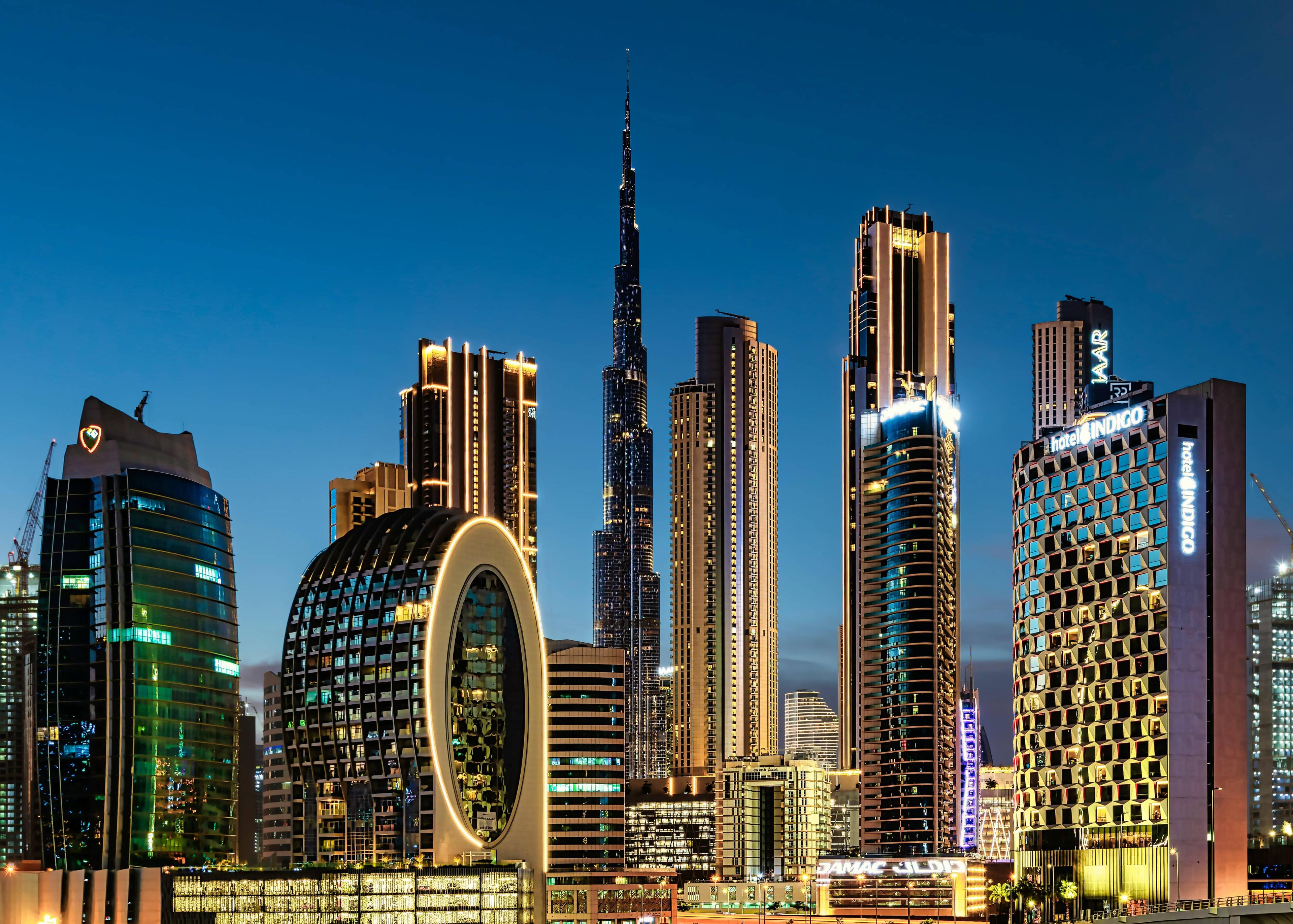
The UAE is the region's – arguably the world's – most complete safety product for foreign families. Homicide around 0.5 per 100,000, street crime rare enough that lost-wallet stories are a local genre, Gallup law-and-order scores at the global summit, and a state whose core promise to its 90% expatriate population is precisely this: nothing will happen to you here.
The family infrastructure is the deepest between Singapore and London: hundreds of international schools, first-rate private healthcare, and entire master-planned districts engineered for expatriate childhoods. For wealth, the proposition is equally explicit – no income tax, Golden Visas from roughly $545,000 in property, and the financial free zones (DIFC, ADGM) running English-law courts precisely so your contracts live under familiar rules.
The honest caveats: the broader legal system is rule by law – efficient, but discretionary at the edges, with occasional cases (business disputes turning criminal, social-media prosecutions) that remind expatriates of the terms. And geography is geography: the missiles that have crossed Gulf skies in recent years didn't ask for visas. Neither caveat has slowed the inflow; both belong in the file.
2. Qatar: The Statistical Champion
By the narrowest definition of safety, Qatar may lead the planet: homicide around 0.3 per 100,000, Gallup's top-tier law-and-order scores year after year, and a capital where the World Cup's greatest security lesson was that there was nothing to police. Wealth per capita – among the world's highest, as our regional wealth coverage details – funds a state apparatus for whom public order is a solved problem.
For families, Doha offers the Gulf standard: international schools (Education City's branch campuses add depth), private healthcare, compound-and-tower living of high quality. The texture is smaller and more conservative than Dubai's – alcohol tightly licensed, social codes closer to the surface – and the expat ecosystem, while large, is thinner in the cultural amenities that make the UAE's scale addictive.
Structurally, Qatar shares the Gulf profile (autocratic stability, regional exposure – it spent 2017-2021 under blockade by its own neighbors, a stress test it passed with strange serenity). As a place where nothing bad happens on the street, it has few rivals anywhere.
3. Oman: The Gentle Sultanate
Oman is the region's connoisseur pick: homicide around 0.5 per 100,000, negligible street crime, and – uniquely in the Gulf – a social temperature that visitors describe in terms usually reserved for Bhutan. The sultanate's foreign policy of friendship-with-everyone (it mediates between adversaries as a national specialty) extends inward: Omani society is courteous, unhurried, and notably free of the region's tensions.
Muscat offers a smaller but real expat infrastructure – international schools, good private healthcare – at costs below Dubai's, with mountains and a wild coastline that make it the Gulf's only entry with weekend scenery. Residence runs through employment and an investor-visa program at modest thresholds. The trade-offs are economic scale (fewer opportunities, quieter professional life) and the succession question any sultanate carries, which Oman's 2020 transition answered more smoothly than analysts predicted.
For families optimizing for calm rather than commerce, Oman is the region's best-kept answer.
4. Kuwait: Order With Institutions
Kuwait posts Gulf-standard street safety – homicide around 1.5 per 100,000, low crime, high order – with a structural feature its neighbors lack: an elected parliament with real power, a noisy press, and constitutional politics that, for all their gridlock, mean Kuwaiti stability doesn't rest on a single decision-maker. In this series' terms, it's the Gulf entry with the most institutional (rather than purely administrative) safety.
The expat experience is the flip side: Kuwait invests less in foreign-resident life than its neighbors – fewer lifestyle amenities, stricter social codes, no alcohol, and a residency system built for workers rather than settlers. Wealthy Kuwaiti families enjoy one of the world's most cushioned existences, as the wealth figures in our regional coverage suggest; foreign families mostly experience Kuwait as a posting rather than a home.
It ranks here on the numbers and the institutions, with the caveat that it isn't really auditioning for you.
5. Bahrain: The Easygoing Entry
Bahrain runs the Gulf model at its most relaxed: homicide around 0.5 per 100,000, easy daily life (the region's most liberal social codes alongside Dubai), the lowest costs of any Gulf state, and a long-standing expatriate community – banking built Manama's foreign population decades before Dubai's boom, as our wealth series noted.
The asterisk is 2011: Bahrain is the one Gulf state with modern memory of serious internal unrest, and though the years since have been calm, the underlying sectarian politics distinguish its risk profile from its neighbors'. The compensations are practical – residence and property access at the Gulf's friendliest price points, the causeway to Saudi Arabia's boom, and a lived ease that makes it many long-term Gulf hands' quiet favorite.
For cost-conscious families wanting Gulf safety without Gulf prices, Bahrain is the arbitrage entry.
6. Saudi Arabia: The Transformer
Saudi Arabia is this list's trajectory pick and its most argued-over entry. The statistics are genuinely strong – homicide around 1 per 100,000, minimal street crime, order kept with unambiguous state capacity – and the transformation since 2017 has rebuilt daily life at a pace with no modern precedent: entertainment, tourism, women driving and working, expatriate compounds giving way to open city living in Riyadh's new districts.
For families, the infrastructure is scaling fast (international schools multiplying, Premium Residency from roughly $213,000 as covered in our regional wealth piece), and for business, the kingdom is where the region's capital actually is. The caveats scale equally: the legal system remains the region's most opaque for foreigners, social codes are in motion rather than settled, and the same concentrated authority driving the opening could drive any future reversal. Administrative safety, in this series' vocabulary, at maximum wattage – impressive, real, and structurally unhedged.
7. Jordan: The Non-Gulf Haven
Jordan closes the list as the region's non-oil safe harbor: homicide around 1.5 per 100,000, decades of internal stability maintained in the world's worst neighborhood, and Amman's standing role – documented in our regional wealth ranking – as the refuge address for capital and families from every surrounding crisis.
The kingdom's safety is a national industry consciously maintained: security services rated among the region's most capable, a monarchy practiced at absorbing shocks, and a social compact that has held through refugee waves that would strain any state. The limits are economic – Jordan is not rich, opportunities are thin, and the wealthy who base here typically earn elsewhere. But as proof that street safety and stability can be produced without hydrocarbons, in that geography, Jordan's fifty-year run is among the more underrated governance achievements anywhere.
The Stability Question
The Gulf entries above share a structure this series has to name honestly. Their safety is real – the statistics are not propaganda, and ten million relocated expatriates are not all wrong. But it is administrative safety in its purest global form: produced by capable, wealthy, unaccountable states, and therefore exactly as durable as those states' management and their neighborhood's restraint. The region's recent years have included a blockade among allies, missile and drone traffic over civilian skies, and a war whose escalations repeatedly tested every capital's calm. None of it dented daily life in Doha or Dubai. All of it belongs in a family's structural file.
The planning conclusion is the one the Gulf's own residents have made standard practice: enjoy the region's extraordinary lived safety, and hold your optionality elsewhere. The typical structure pairs the Gulf base with a second citizenship – the Caribbean programs from our regional ranking are the regional default, with routes like Argentina's and El Salvador's as alternatives – so that the family's right to be somewhere else never depends on the region's weather. In the Gulf more than anywhere, a second passport isn't distrust. It's the local custom.
Frequently Asked Questions
What is the safest country in the Middle East in 2026?
For foreign families weighing everything – street safety, infrastructure, legal predictability for expatriates – the UAE. By pure street-safety statistics, Qatar edges it. Oman is the pick for calm over commerce.
Is Dubai really as safe as people say?
Yes, on the street: crime rates at global-minimum levels and top Gallup safety scores, which is a core reason for the millionaire inflows we've documented. The nuance is structural – a discretionary legal system and regional geography – which careful families hedge rather than ignore.
How safe is Saudi Arabia now?
Statistically, very – homicide around 1 per 100,000 and minimal street crime. The open questions are legal opacity for foreigners and the pace of social change, both improving and both unfinished. It's the region's trajectory story.
Which Middle East countries offer residence to investors?
The UAE (Golden Visa, from ~$545,000 in property), Saudi Arabia (Premium Residency, from ~$213,000), Qatar and Bahrain (property-linked permits), and Oman (investor visas). None offers citizenship in any practical sense – which is why Gulf-based families so often pair residence there with citizenship elsewhere.
Final Thoughts
The Middle East's safe countries are the world's most instructive case study in the difference between the two kinds of safety this series keeps separating. On the street, the Gulf has built something the West should study rather than condescend to: cities of millions where violent crime has been engineered down to statistical noise, and where women and children move more freely at night than in Paris or Los Angeles. Structurally, the same countries concentrate their risk at the top and import it from the neighborhood – unhedged by institutions, hedged instead by each family's own arrangements.
The wealthy residents flooding in understand the deal precisely, which is why the region leads the world in both millionaire inflows and second-passport demand simultaneously. That's not a contradiction. That's the whole strategy, executed correctly – and it's the model this series would prescribe anywhere the streets are safer than the structure.
Related articles