Best Second Passports for Myanmar Citizens in 2026
Best Second Passports for Myanmar Citizens in 2026
Conscription, exit crackdowns, and passport rules built to keep people in. For Myanmar nationals with means, especially those already abroad, a second citizenship is the way out of the trap. This post breaks down available citizenship by investment options in 2026.
Conscription, exit crackdowns, and passport rules built to keep people in. For Myanmar nationals with means, especially those already abroad, a second citizenship is the way out of the trap. This post breaks down the best second passport options for Myanmar citizens in 2026, why each one makes sense, and what they actually cost.
In February 2024, Myanmar's military government activated the conscription law: men 18 to 35 and women 18 to 27, callable for years of service. What followed was one of the most explicit mobility crackdowns anywhere in the world. By May 2024, permits for men to work abroad were suspended. By October 2024, new passport rules split documents into categories, with workers deported for traveling on the wrong type. At the airports, travelers in their twenties and early thirties, men and women, with paperwork in order, get pulled aside, questioned, and turned back.
The pattern is not subtle. The state needs bodies, so the state is closing the exits.
I've been saying this for years. Cash is king. But passport is queen.
Most people think about financial sovereignty and stop there. But what's the point of protecting your wealth if you can't protect your ability to move? A mobility freeze is a cash seizure by another name. Myanmar in 2026 is the starkest version of this equation on earth: it doesn't matter what's in your bank account in Yangon if you're on a list at the airport.
If you're a Myanmar national with means, and especially if you or your assets are already outside the country, the case for a second citizenship isn't theoretical. It's the entire game.
Why Myanmar citizens need a Plan B passport
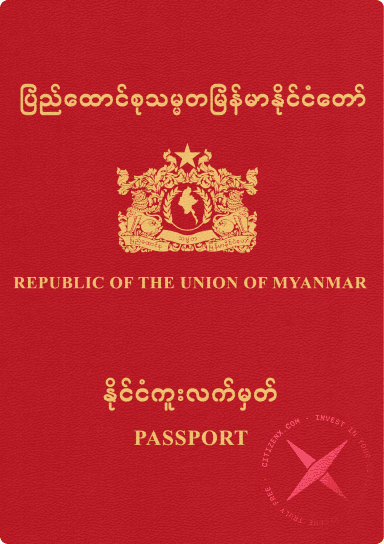
Start with the document. The Myanmar passport reaches roughly 45 to 50 destinations, one of the weakest travel documents in the world. No Schengen, no UK, no US, and visas required nearly everywhere except parts of ASEAN.
But as with every closed system, the passport's weakness is the small problem. The real problem is what the state does with its monopoly on your documents.
Since the conscription activation, that monopoly has been weaponized. Overseas work permits for men: suspended. Passport categories: redesigned so that the state controls not just whether you travel but for what purpose. Airport officers: instructed to filter departures by age. Even people over or under conscription age report intensive interrogation before boarding. Emigration, the ordinary human response to danger, has been reclassified as a leak to be plugged.
Meanwhile the economy runs on informality: multiple exchange rates, forced conversion rules for remittances, banks that international counterparties treat with suspicion. Myanmar has sat on the FATF blacklist since 2022, which means every international transaction touching a Myanmar-documented person attracts enhanced scrutiny, fairly or not.
A second citizenship attacks every layer of this at once. It's a travel document the junta didn't issue and can't cancel. It's an identity that banks don't automatically flag. And it's a legal status that exists regardless of which faction controls the airports.
The honest constraints
I promise every nationality I write for the same thing: no fairy tales. For Myanmar nationals there are three hard constraints, and your plan has to respect all of them.
First, dual citizenship is prohibited under the 1982 Citizenship Law. Acquiring a foreign nationality is grounds for losing your Myanmar citizenship. For most of my readers in most countries, that's a manageable legal wrinkle. For people navigating Myanmar's current politics, it deserves genuine thought and proper advice, quietly obtained.
Second, this path realistically starts from outside the country. If you're inside Myanmar and subject to exit filtering, a CBI application doesn't solve your first problem, which is lawful, safe departure. The realistic sequence runs through legitimate channels: business travel, education, family reunification, or relocation to Thailand, Singapore, or the UAE, where a meaningful Myanmar business diaspora already operates. The citizenship project begins once you and your capital have a stable base abroad.
Third, due diligence will be demanding. Myanmar's FATF status means CBI units and their compliance firms will examine source-of-funds documentation with maximum attention. Wealth earned through legitimate trade, manufacturing, or services is absolutely documentable, and Myanmar applicants with offshore banking history in Singapore or Thailand clear this bar regularly. But expect the file to be thick, the questions detailed, and the timeline longer than the brochure says. No major program formally bans Myanmar nationals; the restricted lists target other countries. Scrutiny, not prohibition, is your obstacle.
If those three constraints make the project sound hard: yes. It's also being completed, every month, by people whose alternative was waiting to see what the state decides for them next.
How citizenship by investment works
Citizenship by investment, or CBI, is straightforward. You make a qualifying financial contribution to a country, usually through a government fund donation or a real estate purchase, and in return you receive citizenship and a passport. The process typically takes three to eight months, longer for complex files.
These aren't fake passports or gray-market documents. CBI programs are run by sovereign governments, regulated by international compliance firms, and recognized worldwide. You go through due diligence, background checks, and, at the Caribbean programs, a mandatory interview. If you pass, you become a citizen with full rights.
Investment amounts in 2026 range from roughly 90,000 USD to 250,000 USD and up, plus fees.
Sao Tome and Principe: the value play
Sao Tome and Principe is a small island nation in the Gulf of Guinea. Its CBI program launched in August 2025, with pricing starting around 90,000 USD for a single applicant through the government donation route. The most accessible credible program on the market.
The passport is modest, roughly 70 destinations, but hold it against the Myanmar baseline: it's a stronger document than the one you were born with, from a neutral country nobody sanctions, at the lowest price in the industry. For a Myanmar family establishing itself in Bangkok or Singapore, it's the entry point to a documented existence that doesn't run through Naypyidaw.
Young program, slower-than-advertised first-year processing, and a new CBI unit's appetite for complex files is less proven. Weigh that honestly against the price advantage.
Vanuatu: the fastest passport on the market
Vanuatu's CBI program has been around since 2017 and has deep experience with Asian applicants. The Development Support Program is the main route, with all-in costs for a single applicant starting around 130,000 to 135,000 USD.
What makes Vanuatu stand out is speed. Approvals can come through in one to two months. For someone whose planning horizon is shaped by a state that changes the rules mid-year, speed is not a convenience. It's the feature.
Know the trade-off: Vanuatu lost its EU visa waiver permanently in December 2024, and the UK pulled its waiver earlier. What remains is a Pacific citizenship with visa-free reach into Singapore, Hong Kong, and much of Asia, which happens to be where Myanmar's business diaspora actually lives and works, plus no income tax, no wealth tax, no inheritance tax, and no capital gains tax.
St Kitts and Nevis: the original and still the benchmark
St Kitts and Nevis launched the world's first CBI program in 1984. Over 40 years of continuous operation.
The main route is the Sustainable Island State Contribution starting at 250,000 USD for a single applicant, with real estate alternatives from 325,000 USD.
For a Myanmar national, the jump is enormous: from under 50 destinations to roughly 150 to 160, including the UK, the entire Schengen area, Singapore, and Hong Kong. This is a passport your family can run an international life on: school runs in London, suppliers in Europe, banking in Singapore, all without a visa appointment. St Kitts due diligence is the industry's most established, which cuts both ways: the file must be immaculate, and when it clears, the document carries corresponding credibility.
Processing runs four to six months, longer for complex files.
Other Caribbean options worth considering
Dominica starts at 200,000 USD for a single applicant. Roughly 140 visa-free destinations including Schengen, and a decade of investment in program integrity. The value route to a top-tier document.
Grenada starts at 235,000 USD. Differentiators: visa-free China, useful for Myanmar trading families, and the US E-2 treaty route, which Myanmar nationals otherwise have no access to, with the caveat that US rules now require three years of domicile in Grenada before investment-acquired citizenship supports an E-2 application.
Antigua and Barbuda starts at 230,000 USD, often the best value for families, with roughly 150 visa-free destinations and a five-day visit requirement within five years.
The strategic framework: how to think about this
For Myanmar clients the framework is a sequence, not a menu.
Step one: base. A lawful, stable residency outside Myanmar for you, your family, and your operating capital. Thailand's investment and retirement tracks, Singapore structures, UAE residency. Without this, nothing else starts.
Step two: file. Build the source-of-funds documentation like the asset it is: contracts, audited accounts where possible, banking history, tax records from your residence jurisdiction. Every month your money spends in a well-regulated banking system, documented, makes your application stronger.
Step three: citizenship. Vanuatu if speed dominates. Sao Tome if budget dominates. Dominica or St Kitts if the goal is the full replacement document, the passport your children's lives run on. Families who can afford it often run two tracks: a fast citizenship now, a Caribbean application in parallel.
Step four: decide, with counsel, how to handle the 1982 law's consequences. For many diaspora families, the practical answer has been that a Myanmar citizenship the state uses as a leash is a strange thing to fight to keep. Others have reasons, property, family, eventual return, to weigh differently. That's a personal decision. Make it deliberately, not by default.
Bitcoin and passports: the sovereign individual toolkit
I keep coming back to this pairing because they solve the same problem from different angles.
Bitcoin in self-custody protects your wealth from seizure, forced conversion, and banking exclusion. A second passport protects your physical freedom from exit filtering and document control. Together, they make you much harder to coerce.
Myanmar's diaspora discovered this without any help from theorists. When the formal remittance channels imposed forced exchange at confiscatory official rates, money found other rails, and crypto was prominent among them. When your home banking system is simultaneously blacklisted abroad and predatory at home, self-custodied value isn't speculation. It's the only neutral ground available.
Governments have two primary leverage points over citizens: their money and their movement. Myanmar's government is currently squeezing both harder than almost any state on earth. The answer is to hold some of each where no government's squeeze can reach.
What the process actually looks like
The first step is choosing your program, which for Myanmar applicants really means choosing your sequence: base, file, citizenship, in that order.
Next comes due diligence preparation, the heart of your application. Clean criminal record. Source of funds documented end to end. Expect requests for more detail than the standard checklist, and treat each one as an opportunity to strengthen the file rather than an insult. Work with agents who have demonstrable experience with Myanmar or comparable high-scrutiny files. This is not the place to economize.
The application involves forms, supporting documents, photos, medical clearance, and the investment or donation funds, handled through an authorized agent. Processing runs from one to two months for Vanuatu to six or more for the Caribbean, and complex files run past the averages.
Costs beyond the investment include due diligence fees (typically 5,000 to 10,000 USD per applicant), agent fees, government processing fees, and legal fees. Budget an additional 20,000 to 50,000 USD on top of the investment for a family application, plus proper legal advice on the Myanmar citizenship-law consequences.
What I'd do if I were a wealthy Myanmar national
I'll be specific because I think vague advice is useless.
If I were a Myanmar national with meaningful assets and I were already in Bangkok, Singapore, or Dubai, here's what I'd do in the next 90 days.
Lock down my residency status where I am, upgrading from visa runs to a durable permit.
Start the source-of-funds file immediately, because it's the long pole in the tent and entirely within my control.
Apply for Vanuatu now, for the speed, and open a Dominica or St Kitts application in parallel if the budget carries it. The fast document ends my dependence on Myanmar paperwork this quarter; the Caribbean document carries the next twenty years.
Keep my family's Myanmar documents current in the meantime, but never build any plan that depends on Naypyidaw renewing anything.
Hold a meaningful portion of liquid wealth in Bitcoin self-custody, a lesson the remittance rules already taught the whole diaspora.
If I were still inside Myanmar, my honest advice is narrower: the project is lawful, safe relocation first. Spend nothing on passports until you and your family are standing somewhere stable.
The bottom line
Myanmar's government has made its position explicit: your labor and your presence are state resources, and the exits are being managed accordingly. Every month, the filtering gets more systematic.
Cash is king. But passport is queen. And when the state treats the passport as an instrument of retention rather than a document of citizenship, the only real answer is a second one it has no power over.
The Myanmar families who will be fine are the ones already building: base, file, citizenship. Start where you are, with what you can control, now.
This article is for informational purposes only and does not constitute legal, tax, or immigration advice. Myanmar law does not permit dual citizenship, and acquiring a foreign nationality carries specific legal consequences for Myanmar citizens. Consult qualified professionals for advice specific to your situation.
CitizenX helps high-net-worth individuals secure second citizenships and build sovereign lifestyles. Contact us to discuss your Plan B.