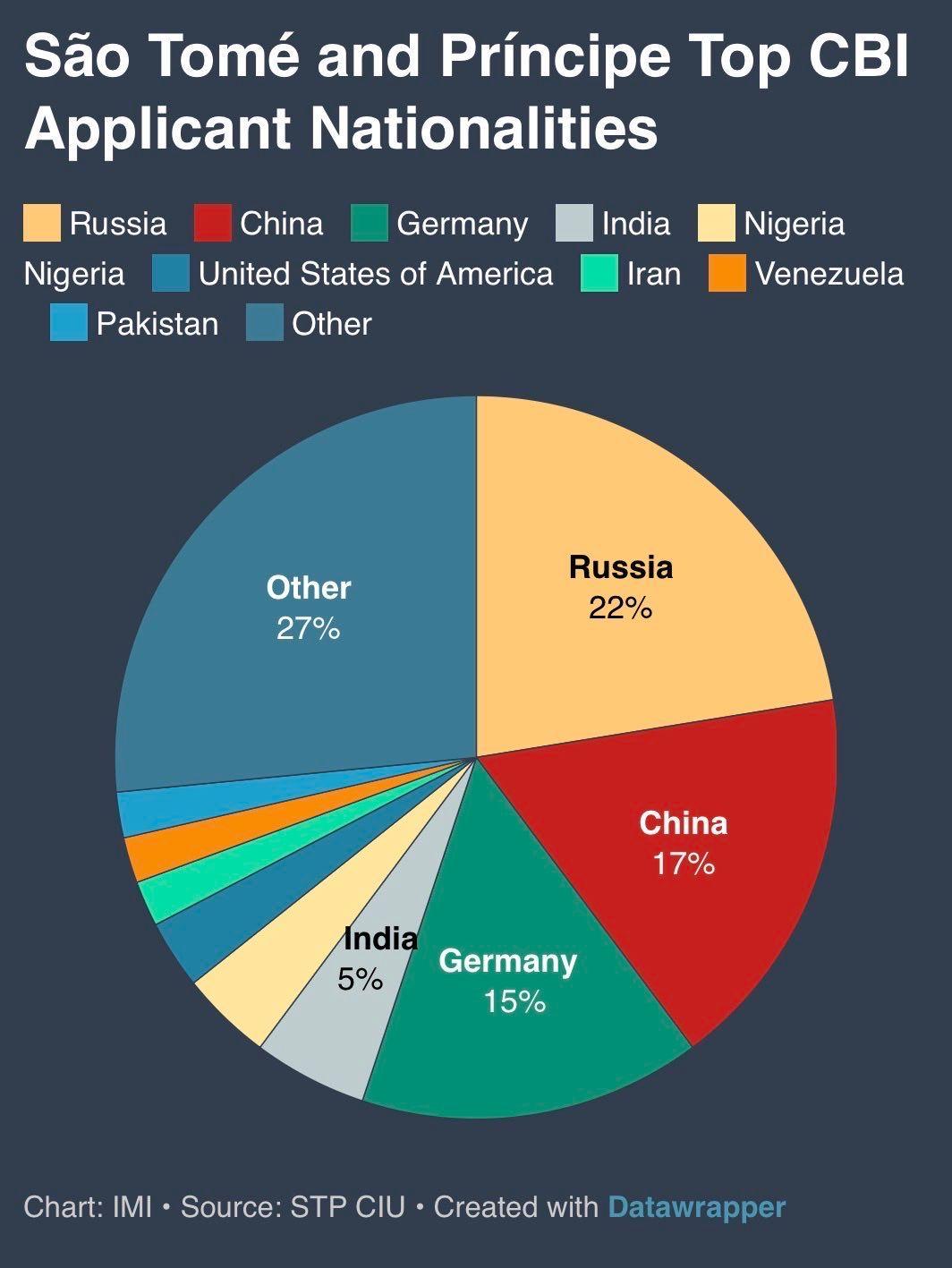
Here is a statistic that surprises most people: Germans are the third-largest applicant nationality in São Tomé and Príncipe's citizenship by investment program. According to figures from the country's Citizenship by Investment Unit, German applicants make up 15 percent of the program's intake, behind only Russia at 22 percent and China at 17 percent, and ahead of India, Nigeria, and the United States.
That is not what the industry expected from a program launched in August 2025. Citizenship by investment has historically been bought by people whose passports limit them. A German passport limits almost nothing. So why are holders of one of the world's most capable travel documents lining up for a two-island nation in the Gulf of Guinea?
The short answer: since June 2024, Germans can legally hold a second citizenship without asking anyone's permission, and São Tomé is the cheapest credible way to get one. This guide covers what changed in German law, what the São Tomé program offers, what it costs in 2026, and how it compares to the alternatives.
Germans can now hold a second passport without losing the first
Until mid-2024, a German citizen who voluntarily acquired another nationality lost their German citizenship automatically, unless they had obtained a retention permit (Beibehaltungsgenehmigung) in advance. The permit process was slow, discretionary, and required proving ongoing ties to Germany. For most people, buying a second passport meant risking the first one.
The Act to Modernise Nationality Law (Staatsangehörigkeitsrechtsmodernisierungsgesetz) ended that. Since June 27, 2024, German citizens may acquire any foreign nationality without losing their German one, and without applying for permission first. The retention permit is gone, and there is nothing to notify.
The effect on demand was immediate and visible in São Tomé's applicant statistics. An entire market of Germans who had wanted a plan B for years, but were unwilling to gamble their German citizenship for it, suddenly had a legal path. Within the program's first year, they became its third-largest nationality group.
A German passport already opens most of the world, and EU citizenship already covers living and working across 27 countries. So travel access has nothing to do with it. What German clients tell us they want is insurance against a narrower and more personal set of risks, and the pattern is consistent.
The exit tax got broader
Germany's exit tax (Wegzugsbesteuerung) has long applied to people who leave the country while holding significant company shares: the state taxes the unrealized gains as if you had sold on the day you left. From January 1, 2025, the rules were extended to private holdings in investment funds and ETFs, catching fund positions above 500,000 euros in acquisition cost or 1 percent of a fund's units. What used to be a concern for company owners is now a concern for successful private investors.
To be clear about what a second citizenship does and does not do here: it does not remove or reduce the exit tax. German tax liability follows residence, not passports. What it does is expand where you can go and how quickly you can restructure your life if you decide the direction of travel in German tax policy no longer works for you. People who watched the exit tax quietly extend from company shares to ETFs tend to ask what gets added next, and they would rather hold options before the answer arrives.
Political uncertainty feels closer than it used to
German clients rarely name a single party or event. What they describe is a loss of confidence in the long-term predictability of German politics: coalition instability, polarization at both ends of the spectrum, recurring debates about wealth taxes and asset registries, and a sense that policy swings between elections are getting wider. Whether or not any specific fear materializes is almost beside the point. The people applying are not predicting a crisis; they are no longer willing to assume there will never be one.
A second citizenship answers that in a way nothing else does. Residence permits can be revoked or left to lapse. Visas expire. Citizenship, once granted, is yours: it does not depend on where you live, it passes to your children under most programs, and no future German government can take it away, because it was never Germany's to give.
One legal identity is a single point of failure
The most common framing we hear from German applicants is not political at all. It is structural. Their banking, travel, residence, and family status all hang on a single government's decisions. These are people who would never run a business on one supplier or hold their savings in one asset, and at some point they noticed their legal existence was the last undiversified position in their portfolio.
Nothing needs to be wrong today. The point of a plan B is optionality that cannot be withdrawn later, when acquiring it might no longer be possible or might cost far more.
What São Tomé and Príncipe offers German applicants
São Tomé and Príncipe is a two-island democracy of about 220,000 people off the coast of Central Africa, a former Portuguese colony and one of the more stable states in the region. Its citizenship program launched on August 1, 2025, with contributions directed to a National Transformation Fund that finances renewable energy, housing, and education projects. The first passports were issued in January 2026.
For a German applicant, the practical features are these.
The process is fully remote. There is no residency requirement, no visit, no language test, and no interview. Applications go through a licensed agent, due diligence is conducted on the government's behalf, and everything can be completed from Germany. That last point matters more than it sounds: several competing programs require in-person biometrics or mandatory interviews, and busy applicants feel the difference.
It is also fast. The government's processing target is around two months, with observed timelines running four to ten weeks. As with any young program, treat that as a target rather than a promise; timelines vary while intake scales up.
Dual citizenship works on both sides: São Tomé allows it, and since June 2024 Germany does too, so a German applicant keeps their German and EU citizenship in full.
Family pricing is unusually generous. A family of two to four people applies with a $95,000 contribution, only $5,000 above the single-applicant rate. Most programs price each dependent separately at every stage.
What it costs in 2026
Item
Amount (USD)
Contribution, single applicant
$90,000
Contribution, family of 2 to 4
$95,000
Application and processing fees
$5,000
Document fees (passport, ID, certificate)
$750
Agent fee
Varies by agent
Government costs before agent fees, single applicant
~$95,750
At roughly $95,750 in government costs for a single applicant, São Tomé is the least expensive credible citizenship program in the world as of mid-2026, and the family pricing makes it cheaper still per person. For a German couple with two children, the contribution works out to under $24,000 per passport before fees.
What the passport itself does
Honesty matters here, because German applicants do not need to be sold on travel access and should not be. The São Tomé passport reaches roughly 60 destinations visa-free or visa-on-arrival, including Singapore and Hong Kong. It does not cover the Schengen Area, the UK, or the United States. For a German, that is irrelevant: your German passport already does all of that, and you will keep using it for travel.
You will probably never board a plane on the São Tomé document. It exists as your fallback legal status, and it comes with one feature no other program at this price offers.
The CPLP dimension: a Lusophone world outside the EU
São Tomé and Príncipe is a full member of the Community of Portuguese Language Countries (CPLP), a nine-nation bloc that includes Portugal, Brazil, Angola, Mozambique, and Cape Verde. CPLP citizenship carries practical mobility rights: entry to Portugal without a prior visa and the ability to apply for a residence permit from inside the country under the CPLP mobility framework, plus simplified residence pathways in other member states.
A German does not need Portuguese residence today; EU citizenship already provides it. So why does this matter? Because the plan B scenario is precisely the one in which your EU rights are no longer the comfortable constant they are now. If the situation you are insuring against involves Germany or the EU itself, an insurance policy whose only strength is EU access insures nothing. The CPLP network gives a São Tomé citizen standing in a community of countries on four continents, anchored by Brazil, a country of 210 million people that is notably welcoming to CPLP citizens and entirely outside the European system.
That is the right shape for a German plan B: legal standing that runs parallel to your EU rights rather than depending on them.
How São Tomé compares to the alternatives
São Tomé is not the only program open to German citizens. It has become the default recommendation for this profile, but the comparison is worth making properly.
Nauru: credible, but pricier and slower
Nauru's Economic and Climate Resilience Citizenship Program funds climate adaptation for the world's smallest republic. Its contribution matches São Tomé's $90,000 under the Iruwa rate available through December 31, 2026 (rising to $105,000 after), but higher fees push all-in single-applicant costs to roughly $127,700 including standard agent fees. Processing takes three to four months, and every principal applicant must attend an interview with a due diligence firm, though it can be held virtually. The passport reaches over 85 destinations including the UAE.
Nauru is a sound program. For a German who values the stronger standalone travel document, it is a reasonable choice. But for pure plan B purposes it costs about a third more than São Tomé, takes longer, adds an interview, and has no equivalent of the CPLP network.
Vanuatu: speed at the cost of process
Vanuatu has run citizenship programs since 2017 and remains one of the fastest, at one to three months for a $130,000 donation. Two caveats for German applicants: biometrics must now be submitted in person in Port Vila or at designated posts abroad, so the process is not remote, and the passport lost its EU and UK visa-free access after the bloc raised vetting concerns. As a backup document for a German the lost EU access matters little, but paying $130,000 plus a mandatory trip for a program with a rockier reputation is hard to justify when São Tomé costs less and asks less.
Turkey: the money comes back, eventually
Turkey grants citizenship for a $400,000 real estate purchase held at least three years. The appeal is that the outlay is an asset rather than a donation: after the holding period you can sell and potentially recover your capital. Processing runs six to eight months. For Germans wary of donating six figures, it is the natural alternative, with two notes. First, you are taking Istanbul property-market risk for three years minimum. Second, the often-cited perk of Turkish citizenship, eligibility for the US E-2 investor visa, adds nothing for Germans, since Germany holds its own E-2 treaty with the United States.
El Salvador: for crypto wealth in a hurry
El Salvador's Freedom Passport issues citizenship in roughly 30 to 45 days for a $1 million contribution paid in Bitcoin or USDT, capped at 1,000 approved applicants per year with family included. For most German buyers the price rules it out. For the subset whose wealth is on-chain and who want the fastest legitimate timeline available, nothing else compares. Full due diligence and sanctions screening still apply.
Side by side
São Tomé
Nauru
Vanuatu
Turkey
El Salvador
German citizens eligible?
Yes
Yes
Yes
Yes
Yes
Minimum cost (single)
~$95,750 plus agent fees
~$127,700 all-in at promotional rate
$130,000 plus fees
$400,000 (recoverable asset)
$1,000,000 (BTC/USDT)
Route
Donation
Donation
Donation or real estate
Real estate
Crypto donation
Timeline
4 to 10 weeks
3 to 4 months
1 to 3 months
The application process, step by step
The mechanics are simpler than most Germans expect, largely because there is no interview and no travel.
Eligibility check. Before any money moves, your background is screened against the program's requirements: age 18 or over, clean criminal record, lawful source of funds. At CitizenX we confirm eligibility before you commit, so you only pay once you know you qualify. To date, we have never had an application rejected.
Document collection. Passport copies, birth and marriage certificates, police clearance, proof of source of funds. German documents need certified translations into English or Portuguese; your agent coordinates this.
Submission and due diligence. The application goes to the Citizenship by Investment Unit through a licensed agent, and independent due diligence is conducted.
Approval and contribution. The contribution to the National Transformation Fund is paid after approval in principle, not before.
Citizenship and passport issuance. You receive a certificate of naturalization, followed by your passport and national ID, delivered without a visit to the islands.
From engagement to passport, plan for roughly two to three months end to end.
Frequently asked questions
Can German citizens legally hold a second passport?
Yes. Since June 27, 2024, German law permits citizens to acquire any foreign nationality without losing German citizenship and without a retention permit. São Tomé and Príncipe also permits dual citizenship, so nothing conflicts on either side.
Do I have to tell the German authorities about a second citizenship?
There is no general notification requirement when a German acquires another nationality after June 2024. Specific contexts, such as security-cleared positions or civil service roles, may have their own disclosure rules.
Does a second passport change my German tax situation?
No. German tax liability follows residence, not citizenship. Acquiring São Tomé citizenship neither removes any German tax obligation nor creates a new one, and it does not by itself trigger or avoid the exit tax. If relocating is part of your plan, get advice from a German tax adviser first; we handle the citizenship side, not the tax side.
Why are so many Germans applying to São Tomé specifically?
Three reasons show up consistently: it is the lowest-cost credible program in the market, the process is fully remote with no interview, and the 2024 change in German nationality law removed the legal barrier that had suppressed German demand for decades. The program's own intake data reflects it: Germans are the third-largest applicant nationality at 15 percent.
Is the São Tomé passport good for travel?
It covers roughly 60 destinations including Singapore and Hong Kong, but not the Schengen Area, the UK, or the US. For Germans this rarely matters. You keep your German passport for travel; the São Tomé citizenship is your fallback legal status, not your boarding pass.
Can I include my family?
Yes. A family of two to four people applies with a $95,000 contribution, barely above the single rate, and citizenship passes to children born after the grant. Many German clients treat the application less as a purchase and more as an inheritance: one application, a second nationality for the family line.
How long does the process take?
The government targets around two months, with observed cases running four to ten weeks. Add time for document collection and translations on the front end; two to three months end to end is a realistic plan.
Is the program safe and legitimate?
The program was created by national legislation, is administered by a government Citizenship by Investment Unit, and requires applications through licensed agents with independent due diligence. As with any program this young, work with an agent who is transparent about timelines and holds the required licenses for the programs they offer.
The bottom line
The German case for São Tomé and Príncipe is unusual in this industry because it has nothing to do with the passport's travel power. Germans hold one of the strongest travel documents on earth and will keep using it. What they did not have, until June 2024, was the legal right to hold a second citizenship at all. Now that they do, they are choosing the program that delivers a permanent, irrevocable second legal status for the least money, with the lightest process, and with a network of Portuguese-speaking countries on four continents behind it.
The intake numbers say plenty of Germans have already run this calculation and reached the same answer. At $90,000, remote, and done in about two months, São Tomé is the cheapest insurance policy of its kind, and the only one at this price attached to a nine-country bloc.
CitizenX helps clients compare and apply to citizenship programs worldwide, including São Tomé and Príncipe, Nauru, Vanuatu, Turkey, and El Salvador. We confirm your eligibility before you pay, and to date we have never had an application rejected. Book a call with our team to work out whether São Tomé fits your situation, budget, and timeline.
Sources: São Tomé and Príncipe Citizenship by Investment Unit intake statistics (via IMI); Act to Modernise Nationality Law (StARModG), in force June 27, 2024; German Foreign Office guidance on retention of citizenship; § 6 AStG as amended January 1, 2025.