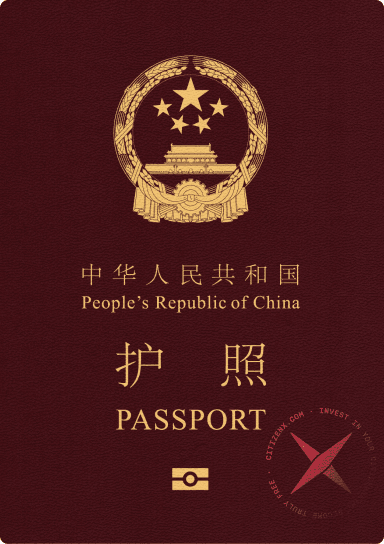
Best Second Passports for Chinese Citizens in 2026
Best Second Passports for Chinese Citizens in 2026
Exit bans are expanding, capital controls are tightening, and passports are being collected by employers. This post breaks down the best second passport options for Chinese citizens in 2026, why each one makes sense, and what they actually cost.
Exit bans are expanding, capital controls are tightening, and passports are being collected by employers. This post breaks down the best second passport options for Chinese citizens in 2026, why each one makes sense, and what they actually cost.
China rewrote its exit rules this summer. On July 31, 2026, the State Council passed new Exit and Entry Administration Provisions, effective September 15. The new framework expands the grounds for blocking citizens from leaving the country, including a provision covering "activities abroad endangering national security or interests" that can keep you inside China for six months to three years after you return. Read that again. Activities abroad. Judged after the fact. By the same authorities who decide whether you board your next flight.
I've been saying this for years. Cash is king. But passport is queen.
Most people think about financial sovereignty and stop there. Bitcoin in self-custody, offshore accounts, maybe some gold. All good. But what's the point of protecting your wealth if you can't protect your ability to move? A mobility freeze is a cash seizure by another name. You can have fifty million yuan in a cold wallet and still be stuck inside borders someone else controls.
Chinese entrepreneurs don't need me to explain this. They've watched colleagues get exit-banned over commercial disputes. They've seen civil servants, teachers, and bank employees ordered to hand their passports to their work units. They've watched the individual forex quota stay frozen at 50,000 USD a year while the enforcement around it got smarter and stricter.
If you're a wealthy Chinese national, or you hold meaningful assets and optionality matters to you, the window to act is now. Not after the next tightening. Now.
Why Chinese citizens need a Plan B passport
The Chinese passport has improved dramatically as a travel document. On the January 2026 Henley Passport Index it reaches 141 destinations visa-free, up more than 30 destinations in a decade. That's real progress.
But it still doesn't get you into the Schengen area, the US, the UK, Canada, or Australia without a visa. And more importantly, a passport's travel score means nothing if you can't use it.
Exit bans are the clearest example. There's no single exit-ban law in China. There's a patchwork of more than a dozen laws and regulations that let courts, police, tax authorities, and state security block a departure. Unpaid judgment against your company? Exit ban. Witness in someone else's investigation? Exit ban. Deemed a national security risk under the 2023 Counter-Espionage Law amendments? Exit ban. Researchers estimate tens of thousands of people are under exit bans at any given time, and judicial exit bans have been roughly doubling year over year.
In 2025 this went fully mainstream. A Wells Fargo banker flew into China and couldn't leave for two months. A US Commerce Department employee was held for most of the year. Wells Fargo suspended all corporate travel to China in response. If foreign citizens with the US government behind them can get stuck, think about what that means for a Chinese national with a business dispute and no embassy to call.
Then there's the passport collection campaign. Party members, civil servants down to low-level staff and retirees, teachers, SOE employees, and bank staff have been required to surrender their passports to their employers and apply for permission before any foreign trip. The official line is that unauthorized foreign travel is "not a trivial private matter." That tells you everything about the direction of travel.
A second passport isn't about getting into more countries. It's about making sure you always have a document that no work unit can collect and no domestic database controls.
The capital controls factor
Let me be direct about this because it changes how Chinese clients need to plan.
The individual foreign exchange quota remains 50,000 USD per year, and it legally covers current-account items only: travel, tuition, medical costs, consumption. Overseas property, securities, insurance, and investment migration payments don't fit inside it. And enforcement is getting sharper, not looser. Rules that took effect January 1, 2026 lowered the KYC verification threshold on cross-border transfers to roughly 1,000 USD, extended record-keeping from five years to ten, and added analytics specifically designed to catch quota-splitting through relatives and friends, the classic "ants moving house" method. That route was always illegal. Now it's also likely to get caught.
The practical implication: a CBI application should be funded from assets that are already offshore. Overseas business income, Hong Kong accounts, proceeds from foreign structures set up properly under the outbound investment rules. If your wealth is entirely onshore, your first conversation isn't with a CBI unit, it's with a cross-border tax and legal advisor. Do this cleanly or don't do it. Source-of-funds documentation is the heart of every CBI due diligence process, and a passport application built on smurfed transfers is a rejection waiting to happen.
This is also the strongest argument for acting early. Every year, the compliance net tightens. The people who moved assets offshore legally in 2015 have options today that are much harder to replicate in 2026.
The dual citizenship problem, and how to think about it
Here's where China differs from almost every other market I write about, and I'm not going to sugarcoat it.
The PRC Nationality Law does not recognize dual nationality. Article 9 says a Chinese national who has settled abroad and voluntarily acquires a foreign nationality automatically loses Chinese citizenship. If the authorities conclude you've naturalized elsewhere, the consequences are concrete: cancellation of your hukou, your Chinese passport, and your national ID, with everything that flows from that for property, banking, healthcare, and your children's schooling.
Notice the two conditions: settled abroad, and voluntary acquisition. A Chinese national living in China who acquires a CBI passport sits in a genuine legal gray zone, and enforcement has historically been uneven. Hundreds of thousands of Chinese have acquired Caribbean and Pacific citizenships over the past two decades. Chinese nationals have historically been the single largest buyer demographic in the entire CBI industry. Draw your own conclusions about how those two facts coexist.
But the risk profile is changing. Border systems are biometric now. Exit records get cross-checked. CRS data exchange exposes accounts opened on foreign passports. I tell Chinese clients three things. First, understand that this is a real legal risk unique to your situation, and get specific advice from PRC-qualified counsel before you apply. Second, permanent residency abroad does not trigger any of this, which is why residency programs are the conservative first layer for mainland-resident clients. Third, for those who proceed with citizenship anyway, the value proposition isn't a travel upgrade. It's an irrevocable legal status in another sovereign territory that exists whether or not Beijing approves of you this year.
I'm not going to tell you where to land on that trade-off. I'll tell you that thousands of your compatriots have already made it, quietly, and that the ones who did it early and cleanly are glad they did.
How citizenship by investment works
Citizenship by investment, or CBI, is straightforward. You make a qualifying financial contribution to a country, usually through a government fund donation or a real estate purchase, and in return you receive citizenship and a passport. The process typically takes three to eight months, sometimes less.
These aren't fake passports or gray-market documents. CBI programs are run by sovereign governments, regulated by international compliance firms, and recognized worldwide. You go through due diligence, background checks, and since 2024, mandatory interviews at the Caribbean programs. If you pass, you become a citizen with full rights.
Investment amounts in 2026 range from roughly 90,000 USD on the lower end to 250,000 USD and up for the premium Caribbean programs, after the region-wide price floor agreed in 2024.
Sao Tome and Principe: the newest option on the market
Sao Tome and Principe is a small island nation in the Gulf of Guinea, off the west coast of Central Africa. Population around 230,000. Its CBI program launched in August 2025, and pricing starts at around 90,000 USD for a single applicant through the government donation route, making it the most accessible credible program on the market.
For Chinese applicants, Sao Tome has a specific appeal: it's under the radar. Less media scrutiny, less political noise, and a program young enough that it hasn't accumulated the geopolitical baggage of the older options. The passport itself is modest, but if your primary goal is a second legal status rather than a travel document, the math works.
It's a Portuguese-speaking country with historical ties to Portugal and the broader Lusophone world, which opens interesting long-term doors. The program is new, though, and processing has been slower than advertised in its first year. Price it accordingly: you're an early adopter.
Vanuatu: the fastest passport on the market
Vanuatu's CBI program has been around since 2017 and has processed thousands of applications, a large share of them from Chinese-speaking markets. The Development Support Program is the main route, with all-in costs for a single applicant starting around 130,000 to 135,000 USD.
What makes Vanuatu stand out is speed. Approvals can come through in one to two months. Nobody else is close.
One thing you need to know: Vanuatu lost its EU visa waiver. The European Council fully ended visa-free access for Vanuatu passport holders in December 2024 over due diligence concerns, and the UK pulled its waiver earlier. So the Vanuatu passport is not a European travel document anymore. What it still is: the fastest route to a sovereign second citizenship on earth, from a country with no income tax, no wealth tax, no inheritance tax, and no capital gains tax.
For a Chinese client whose priority is having the insurance policy in hand quickly, Vanuatu remains the speed play. For travel, you'd pair it with something else or keep using your Chinese passport where it works.
St Kitts and Nevis: the original and still the benchmark
St Kitts and Nevis launched the world's first CBI program in 1984. Over 40 years of continuous operation. That track record matters, especially in an era where programs get suspended under international pressure.
The main route is the Sustainable Island State Contribution starting at 250,000 USD for a single applicant, with real estate alternatives from 325,000 USD.
Here's where the calculation differs from my advice to European clients: for a Chinese national, the St Kitts passport is a genuine travel upgrade. It reaches roughly 150 to 160 destinations visa-free, including the UK, the entire Schengen area, Hong Kong, and Singapore. Visa-free Europe is something your Chinese passport cannot give you. For business travelers who are tired of Schengen visa appointments, this alone changes daily life.
Processing runs four to six months with thorough due diligence. It's the premium option, and it's priced like one.
Other Caribbean options worth considering
Dominica now starts at 200,000 USD for a single applicant after the 2024 region-wide price agreement. The passport covers roughly 140 destinations including Schengen. Dominica has spent a decade building a reputation for program integrity, and it has a long history of processing Chinese applications.
Grenada starts at 235,000 USD through the National Transformation Fund. Two things make Grenada specifically interesting for Chinese nationals. First, Grenada has visa-free access to China itself, which matters for maintaining ties if your status ever changes. Second, Grenada is the classic route to the US E-2 treaty investor visa, which is not available to PRC nationals directly. One major caveat: US law now requires E-2 applicants who acquired treaty citizenship through investment to have been domiciled in that country for three continuous years. The workaround is narrower than it was. If E-2 is your goal, get current US immigration advice before you commit. Don't let an agent sell you a 2019 story in 2026.
Antigua and Barbuda starts at 230,000 USD through the National Development Fund and is often the best value for families. Note the requirement to spend at least five days in the country during the first five years.
The strategic framework: how to think about this
Start with why. If your primary concern is having a second legal status quickly and quietly, Vanuatu for speed or Sao Tome for value and low profile. If you want a genuine travel upgrade over your Chinese passport, the Caribbean programs are the play: St Kitts, Grenada, Dominica, or Antigua all unlock visa-free Europe. If US business access matters, Grenada, with the E-2 caveats above.
For mainland-resident clients who aren't ready for the nationality-law gray zone, flip the order: residency first. A golden visa or residency permit in a stable jurisdiction gives you a legal landing spot without touching your Chinese citizenship at all. Citizenship can come later, from a safer vantage point, once you're genuinely settled abroad and the legal picture is clean.
The Chinese clients I work with mostly fall into two camps. Those already offshore, with foreign PR, offshore assets, and international lives, treat a CBI passport as the final piece and usually go Caribbean. Those still onshore start with asset structuring and residency, and hold citizenship as step three.
Bitcoin and passports: the sovereign individual toolkit
I keep coming back to this pairing because they solve the same problem from different angles.
Bitcoin in self-custody protects your wealth from seizure and capital controls. A second passport protects your physical freedom from exit bans and passport confiscation. Together, they make you much harder to coerce.
Nowhere on earth is this logic more obviously true than China. The state controls the banking system, monitors transfers above 1,000 USD, collects passports from millions of its own employees, and operates the world's most sophisticated exit-control infrastructure. Governments have two primary leverage points over citizens: their money and their movement. China has invested heavily in both. Addressing both is the only response that actually changes your position.
People hear this and think it sounds paranoid. The Chinese entrepreneurs I talk to don't think it sounds paranoid at all. They've lived through the education-sector crackdown, the tech crackdown, the exit-ban wave. They know the rules can change overnight because they've watched it happen, repeatedly, to people they know.
What the process actually looks like
The first step is choosing your program based on your priorities, budget, and timeline.
Next comes due diligence preparation. You'll need a clean criminal record, a legitimate and documentable source of funds, and paperwork to prove both. This is the make-or-break stage for Chinese applicants. Funds should be offshore and their history should be clean and traceable. CBI programs have gotten significantly stricter, all Caribbean programs now interview applicants, and the days of casual paperwork are over.
The application itself involves forms, supporting documents, photos, medical clearance, and the investment or donation funds, handled through an authorized agent. Processing runs from one to two months for Vanuatu up to six months or more for the Caribbean and Sao Tome.
Costs beyond the investment include due diligence fees (typically 5,000 to 10,000 USD per applicant), agent fees, government processing fees, and legal fees. Budget an additional 20,000 to 50,000 USD on top of the investment for a family application. For Chinese applicants I'd add one more line item: proper PRC legal advice on the nationality question before you file anything.
What I'd do if I were a wealthy Chinese national
I'll be specific because I think vague advice is useless.
If I were a Chinese national with a net worth above 20 million yuan and meaningful assets already offshore, here's what I'd do in the next 90 days.
Get PRC-qualified legal advice on my nationality-law exposure and my capital position. Everything else builds on this.
If I'm already living abroad or spend most of my time outside China, apply for a Caribbean citizenship now. St Kitts or Dominica depending on budget. The travel upgrade is real and the legal foundation is permanent.
If I'm still mainland-based, secure a strong residency first, then run the citizenship application from that position once my center of life has genuinely moved.
Move a meaningful portion of liquid wealth into Bitcoin self-custody. Not all of it. But enough that if my accounts were frozen tomorrow, I could still function.
Keep the whole structure clean. No smurfed transfers, no undocumented cash, no shortcuts. The compliance environment in 2026 punishes shortcuts more reliably than ever.
All of this is about optionality. None of it requires you to be disloyal to anywhere. You're diversifying your personal sovereignty the same way you'd diversify an investment portfolio.
The bottom line
China's new exit provisions take effect September 15, 2026. The capital-control net tightened in January. The passport collection campaigns keep widening. Every one of these moves points the same direction: the state is building more control over who moves, and fewer people get to decide for themselves.
Cash is king. But passport is queen. And for Chinese citizens, the queen has never been harder to get, or more valuable to hold.
Don't wait for the next tightening to figure this out. By then the compliant paths will be narrower, and you'll be standing in line with everyone else who thought they had more time.
This article is for informational purposes only and does not constitute legal, tax, or immigration advice. Chinese nationality law carries specific risks around foreign citizenship acquisition. Consult qualified professionals, including PRC-qualified counsel, for advice specific to your situation.
CitizenX helps high-net-worth individuals secure second citizenships and build sovereign lifestyles. Contact us to discuss your Plan B.