Best Second Passports for Egyptian Citizens in 2026
Best Second Passports for Egyptian Citizens in 2026
Egyptians have watched their savings halve in dollar terms more than once in a decade. A second passport fixes what the pound, the visa queues, and the conscription office can't. This post breaks down the best citizenship investment options for Egyptian citizens in 2026.
title: "Best Second Passports for Egyptian Citizens in 2026"
slug: "best-second-passport-egyptian"
author: "Alex Recouso"
published: 2026-08-06
description: "Egyptians have watched their savings halve in dollar terms more than once in a decade. A second passport fixes what the pound, the visa queues, and the conscription office can't. This post breaks down the best options for Egyptian citizens in 2026."
Egyptians have watched their savings halve in dollar terms more than once in a decade. A second passport fixes what the pound, the visa queues, and the conscription office can't. This post breaks down the best second passport options for Egyptian citizens in 2026, why each one makes sense, and what they actually cost.
Here's a fact that tells you everything about how Egypt's own government sees this market: Egypt sells citizenship. There's an official Egyptian citizenship by investment program, priced in hard currency, marketed to foreigners. And Egyptian law explicitly permits its own citizens to hold second nationalities, with the Interior Ministry's permission. The state understands perfectly well that citizenship is an asset with a price. The only question is whether you're on the buying side or just the holding side.
Wealthy Egyptians figured this out generations ago. The old families have long kept a foot in London, Paris, or Geneva. What's changed is that the tools have been democratized: you no longer need a grandfather with a European birth certificate. You need a qualifying investment and a clean file.
I've been saying this for years. Cash is king. But passport is queen.
Most people think about financial sovereignty and stop there. But what's the point of protecting your wealth if you can't protect your ability to move? A mobility freeze is a cash seizure by another name. Egyptians have lived the milder versions: currency crises where dollars vanished from the banking system, import restrictions, years when getting meaningful sums out of the country legally was a project in itself.
If you're a wealthy Egyptian, the window to act is when things are calm. Which is to say: now.
Why Egyptians need a Plan B passport
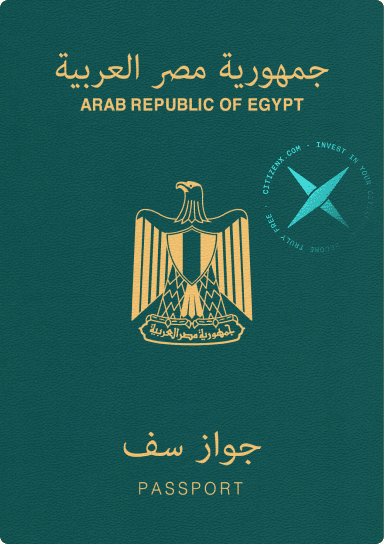
Start with the document. The Egyptian passport reaches roughly 50 destinations visa-free, ranking near the bottom third globally. No Schengen, no UK, no US, no Gulf states without paperwork. For one of the region's great commercial nations, the mismatch is brutal: Egyptian entrepreneurs run businesses across three continents on a passport that requires a visa appointment for nearly all of them.
Every Egyptian businessperson knows the ritual: the embassy queues, the bank statements, the invitation letters, the two-week waits that turn a Frankfurt trade fair into a two-month planning exercise. Multiply that by every partner meeting, every supplier visit, every child's university open day, and you have a permanent tax on your time that Europeans never see.
Then the structural picture. The pound has been devalued repeatedly, most dramatically in the 2016 flotation and again through the 2022-2024 crisis, when it lost half its dollar value and FX rationing returned to the banking system. Inflation ran hot enough to reshape household budgets. None of this is a secret and none of it is finished: the IMF program, the Gulf bailouts, and the parallel-market episodes are a cycle Egyptians have seen enough times to recognize.
Add conscription: mandatory military service for men aged 18 to 30, with the travel restrictions that come with unresolved status. Young Egyptian men can't simply leave for study or work without settling their position with the recruitment office first. The state's claim on your sons' time comes with a claim on their movement.
A second passport isn't about abandoning Egypt. It's about making sure your family's mobility, banking, and legal status don't all depend on a single system that has rationed all three within living memory.
The dual citizenship framework: Egypt's asterisk
Unlike most countries I write about in this situation, Egypt allows dual citizenship. But there's an asterisk, and you need to respect it.
Under Law 26 of 1975, an Egyptian who wants to acquire a foreign nationality should obtain permission from the Ministry of Interior first, and when doing so, explicitly declare the intention to retain Egyptian nationality. Handled correctly, you end up with both passports, fully legally. Handled carelessly, the law contains traps: acquire without permission and you technically remain Egyptian but expose yourself to discretionary revocation; acquire with permission but without the retention declaration and you can lose Egyptian nationality by operation of law, with a limited window to claw it back.
In practice, the permission process is a well-trodden administrative path through the Nationality Department or your consulate, taking a few months. Thousands of Egyptians complete it every year. But do it properly, in the right order, with counsel. The difference between "dual citizen" and "accidentally not Egyptian anymore" is paperwork sequencing.
One more Egypt-specific note: for men, military service status interacts with everything. Egypt has offered exemption settlements for Egyptians abroad, including a 5,000 dollar exemption payment introduced for expatriates. If your sons' status is unresolved, resolving it is part of the same project as the passport, not a separate errand.
How citizenship by investment works
Citizenship by investment, or CBI, is straightforward. You make a qualifying financial contribution to a country, usually through a government fund donation or a real estate purchase, and in return you receive citizenship and a passport. The process typically takes three to eight months.
These aren't fake passports or gray-market documents. CBI programs are run by sovereign governments, regulated by international compliance firms, and recognized worldwide. You go through due diligence, background checks, and, at the Caribbean programs, a mandatory interview. If you pass, you become a citizen with full rights.
Egyptians are accepted at every major program with no nationality-based restrictions. Standard due diligence applies, with the usual emphasis on source-of-funds documentation. Egyptian wealth held through the banking system, real estate, and documented businesses papers well; wealth that lives in cash and informal channels needs structuring first.
Investment amounts in 2026 range from roughly 90,000 USD to 250,000 USD and up, plus fees. Fund the investment from offshore holdings where possible; moving fresh capital out of Egypt has its own compliance considerations, and your banker should be in the conversation early.
Sao Tome and Principe: the value play
Sao Tome and Principe is a small island nation in the Gulf of Guinea, off the west coast of Central Africa. Its CBI program launched in August 2025, with pricing starting around 90,000 USD for a single applicant through the government donation route. The most accessible credible program on the market.
The passport is modest, roughly 70 destinations, but it's still a meaningful upgrade over the Egyptian baseline, from a fellow African state with no political baggage in the region. For Egyptians who want the second legal status established at minimum cost, with the travel upgrade to follow later, this is the entry point.
Young program, slower-than-advertised first-year processing. You're an early adopter. Price that in.
Vanuatu: the fastest passport on the market
Vanuatu's CBI program has been around since 2017. The Development Support Program is the main route, with all-in costs for a single applicant starting around 130,000 to 135,000 USD.
What makes Vanuatu stand out is speed. Approvals can come through in one to two months. Nobody else is close.
Know the trade-off: Vanuatu lost its EU visa waiver permanently in December 2024, and the UK pulled its waiver earlier, so it won't fix your Schengen problem. What it offers is the fastest second citizenship available, from a country with no income tax, no wealth tax, no inheritance tax, and no capital gains tax. For Egyptians already building lives around the Gulf, where residency handles the day-to-day and the passport question is about legal redundancy, Vanuatu's speed is the selling point.
St Kitts and Nevis: the original and still the benchmark
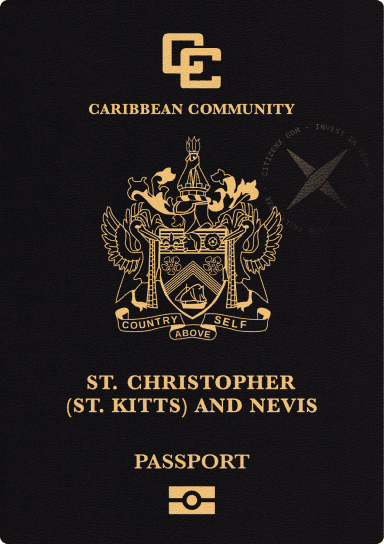
St Kitts and Nevis launched the world's first CBI program in 1984. Over 40 years of continuous operation. That track record matters.
The main route is the Sustainable Island State Contribution starting at 250,000 USD for a single applicant, with real estate alternatives from 325,000 USD.
For an Egyptian, this is the full transformation: roughly 150 to 160 destinations visa-free, including the UK, the entire Schengen area, Singapore, and Hong Kong. The embassy-queue ritual disappears from your life. London, the second home of Egyptian business for a century, becomes a plane ticket instead of a paperwork campaign.
Processing runs four to six months with thorough due diligence. The premium option, priced like one.
Other Caribbean options worth considering
Dominica starts at 200,000 USD for a single applicant. Roughly 140 visa-free destinations including the Schengen area, and a decade-long reputation for program integrity. The value entry to visa-free Europe, and usually where I point cost-conscious buyers who still want the full travel upgrade.
Grenada starts at 235,000 USD through the National Transformation Fund. Its differentiators: visa-free access to China, and the US E-2 treaty investor route. Egypt happens to be an E-2 treaty country itself, so Egyptians can pursue E-2 on their own citizenship, which removes Grenada's headline advantage for most Egyptian buyers. Pay Grenada's premium for the passport strength and China access if those matter, not for E-2.
Antigua and Barbuda starts at 230,000 USD and is frequently the best per-person value for families, with roughly 150 visa-free destinations. Note the five-day visit requirement within the first five years.
The strategic framework: how to think about this
Start with why.
If your dominant pain is travel friction, and for most Egyptian business families it is, the Caribbean programs are the direct answer. Dominica is the value route to visa-free Europe; St Kitts is the premium version; Antigua often wins for large families, and Egyptian families are large.
If your dominant concern is currency and banking risk, remember the passport is one layer of a stack that also includes offshore accounts and hard assets. A second citizenship makes every other layer easier: banks in Dubai, Singapore, and Europe treat a Caribbean-documented client differently from one whose entire identity runs through a capital-controls jurisdiction.
If you're Gulf-based already, your UAE or Saudi residency handles daily life, and the citizenship question is about permanence: residencies expire and depend on employment or sponsorship; citizenship doesn't. That's the gap a CBI passport closes.
And in every case, run the Egyptian permission process correctly, in the right order. The whole point is to end up with two citizenships, not to fumble one acquiring the other.
Bitcoin and passports: the sovereign individual toolkit
I keep coming back to this pairing because they solve the same problem from different angles.
Bitcoin in self-custody protects your wealth from devaluation and banking restrictions. A second passport protects your mobility from visa regimes and exit frictions. Together, they make you much harder to coerce.
Egyptians don't need the devaluation lecture. Anyone who held pounds through 2016 or 2022-2024 watched the state solve its balance-of-payments problem with their savings. Twice. The dollars-under-the-mattress instinct is already national culture; self-custodied Bitcoin is that instinct with better properties: it crosses borders without declaration forms, and there's no version of an FX rationing regime that reaches it.
Governments have two primary leverage points over citizens: their money and their movement. Egypt has exercised the first repeatedly and meters the second through visa dependence and service status. Address both and the power dynamic shifts.
What the process actually looks like
The first step is choosing your program based on priorities, budget, and family size.
Next comes the Egyptian side: initiate the Interior Ministry permission process with the retention declaration, and resolve any military service questions for male applicants. Run this in parallel with, or ahead of, the CBI application.
Then due diligence preparation. Clean criminal record, legitimate source of funds, documentation for both. Egyptian applicants with organized banking and business records clear this routinely.
The application involves forms, supporting documents, photos, medical clearance, and the investment or donation funds, handled through an authorized agent. Processing runs from one to two months for Vanuatu to six months or more for the Caribbean and Sao Tome.
Costs beyond the investment include due diligence fees (typically 5,000 to 10,000 USD per applicant), agent fees, government processing fees, and legal fees. Budget an additional 20,000 to 50,000 USD on top of the investment for a family application, plus Egyptian counsel for the nationality permission and, where relevant, service settlements.
What I'd do if I were a wealthy Egyptian
I'll be specific because I think vague advice is useless.
If I were an Egyptian with a net worth above 2 million dollars, here's what I'd do in the next 90 days.
File for Interior Ministry permission with the retention declaration now. It takes months and gates everything else, so it goes first.
Start a Dominica or St Kitts application for the whole family, funded from offshore holdings. The travel upgrade alone justifies it; the insurance is free on top.
Settle the military service status of any sons approaching eighteen, using the expatriate settlement route where applicable, before it constrains their movement.
Move a meaningful portion of liquid wealth out of pound-denominated exposure into hard assets, including Bitcoin in self-custody, held outside the Egyptian banking system. Not because collapse is imminent, but because the cycle is the cycle, and the people who convert during the calm get better rates than the people who queue during the crisis.
Establish or maintain a Gulf residency as the operational base that ties it together.
All of this is legal. Egypt itself acknowledges the logic; it sells citizenship too. You're diversifying your personal sovereignty the same way you'd diversify an investment portfolio.
The bottom line
Egypt permits dual citizenship, the programs accept Egyptians, and the gap between what an Egyptian passport does and what a 200,000 dollar Caribbean passport does is among the widest value propositions in this entire industry.
Cash is king. But passport is queen. Egyptians have spent a decade learning what happens to cash that lives in one currency, in one banking system, under one government. The lesson applies to citizenship too.
Don't wait for the next devaluation cycle or the next FX squeeze to figure this out. The best time to build the exit was during the last crisis. The second-best time is now, while everything is calm enough to do it properly.
This article is for informational purposes only and does not constitute legal, tax, or immigration advice. Egyptian law requires prior permission for the acquisition of foreign nationality; consult qualified Egyptian counsel to sequence the process correctly.
CitizenX helps high-net-worth individuals secure second citizenships and build sovereign lifestyles. Contact us to discuss your Plan B.